Search engine optimization for law firms is not the same discipline as SEO for a plumber, a dentist, or an e-commerce store. The stakes per click are higher, the compliance rules are stricter, and the buying cycle compresses into hours for some practice areas and stretches across months for others. An agency that treats your firm like any other local business will produce mediocre results and charge you a retainer for the privilege.
This guide covers how attorney SEO actually works in 2026 — what moves rankings, what wastes money, and how to evaluate whether the work being done on your behalf is worth what you are paying for it. It is written from the perspective of someone who practiced law for seventeen years before building marketing systems for other firms.
- Legal SEO splits into three distinct battlegrounds: the Map Pack, organic results, and AI-generated answers. Each requires different work.
- Most law firms lose on local before they ever lose on organic. Your Google Business Profile usually matters more than your blog.
- Content that ranks in legal is content that answers the specific question a distressed person typed — not content that lists services.
- Bar advertising rules apply to every word on your website. Generic SEO agencies routinely produce non-compliant pages.
- SEO is measured in signed cases, not traffic. A page that brings 5,000 visitors and zero retainers has failed.
How Legal Search Actually Works
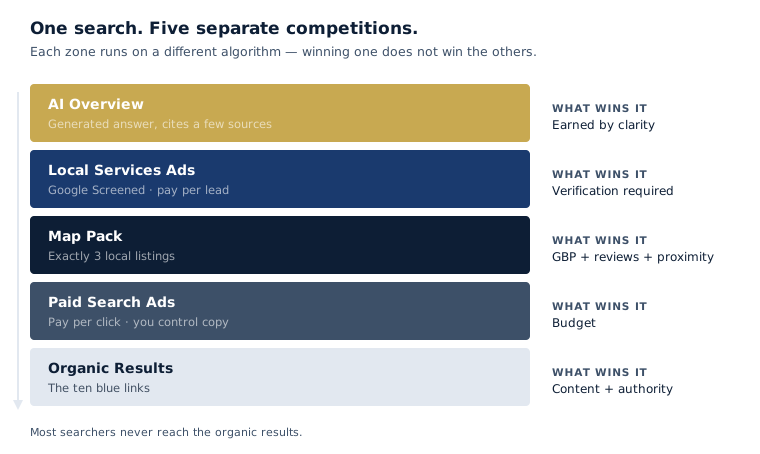
When someone searches for an attorney, Google returns a stacked page with several distinct zones competing for the same click. Understanding which zone you can realistically win determines where your budget should go.
At the very top sit paid advertisements — Google Ads and, in some markets, Local Services Ads with the Google Screened badge. Below those sits the Map Pack, a block of exactly three local business listings pulled from Google Business Profiles. Beneath the Map Pack come the traditional organic results, the ten blue links. Increasingly, an AI Overview sits above or between all of these, summarizing an answer and citing a handful of sources.
Here is what most attorneys do not realize: these zones are governed by separate algorithms. Ranking first organically does not put you in the Map Pack. Dominating the Map Pack does not mean you appear in AI Overviews. A firm can be invisible in one zone and dominant in another, and the work required to fix each is entirely different.
Why the Map Pack usually comes first
For most firms — particularly solo attorneys and practices with fewer than five lawyers — the Map Pack is the highest-leverage place to start. It requires no domain authority, no years of link building, and no content library. It requires a properly claimed, fully optimized, actively maintained Google Business Profile, and a sustained review strategy.
Organic rankings for a term like "personal injury lawyer Los Angeles" may take eighteen months and a six-figure content and link investment to crack. Map Pack visibility for the same geography can move in sixty to ninety days for a firm that has simply never done the work. That asymmetry is why we almost always start clients on Google Business Profile management before anything else.
The Four Pillars of Attorney SEO
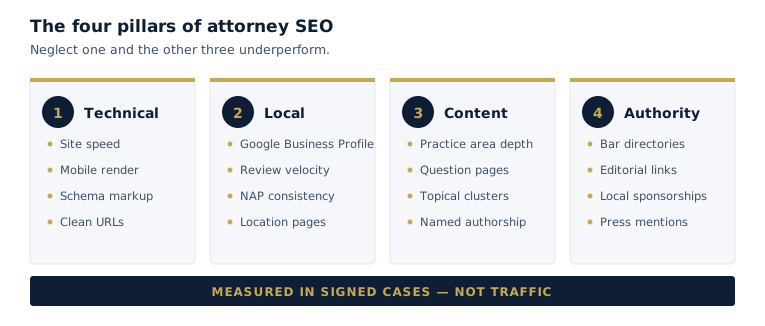
Every credible legal SEO program rests on four pillars. Neglect any one and the others underperform.
Technical foundation
Site speed, mobile rendering, crawlability, structured data, clean URL architecture, HTTPS, and no duplicate or thin pages. This is table stakes. A slow site with broken schema will cap every other effort you make. Most law firm sites built on bloated page builders fail Core Web Vitals outright.
Local presence
Google Business Profile completeness and activity, NAP consistency across directories, review volume and velocity, and location-specific pages if you serve multiple areas. This is what drives Map Pack placement and a large share of phone calls.
Content depth
Practice area pages that go deep rather than wide, question-driven pages that capture how real clients search, and supporting content that establishes topical authority. Thin 400-word practice area pages do not rank in legal anymore.
Authority signals
Editorial links from legitimate sources, bar association and legal directory listings, local sponsorships, press mentions, and the trust signals that tell Google a real firm stands behind the website. Purchased link packages are a liability, not an asset.
Content That Ranks in Legal
The single most common failure in law firm content is writing for the firm rather than the client. A page titled "Our Personal Injury Practice" that opens with "Our attorneys have decades of combined experience" answers no question anyone typed into Google.
Compare that to a page titled "What Happens If the Other Driver Has No Insurance in California?" — a question thousands of people search every month, with clear commercial intent, that only an attorney can credibly answer. The second page ranks. The first does not.
Structuring a practice area page that performs
A practice area page that competes in 2026 needs substantially more than a service description. At minimum it should cover what the legal process actually looks like step by step, what the client can expect in terms of timeline, how fees work in that practice area, what makes cases succeed or fail, jurisdiction-specific rules that apply, and genuine answers to the questions clients ask in a first consultation.
That is typically 1,500 to 3,000 words for a competitive practice area, organized with clear headings, supported by internal links to related pages, and marked up with appropriate schema. It is not filler — every section should be something you would actually say to a client sitting across the desk.
Before publishing any page, ask: would I hand this to a prospective client in my office? If the answer is no, it is not good enough to rank. Google's helpful content systems are explicitly designed to identify and suppress content written for search engines rather than people.
Question-driven content and the long tail
Head terms like "divorce lawyer Chicago" are brutally competitive and often dominated by firms with fifteen-year-old domains and enormous link profiles. The long tail is where a smaller firm wins. Terms like "can my spouse take my retirement account in an Illinois divorce" have lower volume but far less competition and dramatically higher intent.
Build twenty of those pages, interlink them properly to your main practice area page, and you accomplish two things: you capture traffic your larger competitors ignore, and you signal topical depth to Google that strengthens your main page's ability to compete for the head term.
Want to know where your firm actually stands?
A free audit covering your Map Pack position, organic visibility, competitor gap, and the specific reasons your firm is or is not ranking. Reviewed personally, not generated by software.
Link Building Without Getting Burned
Links remain a primary ranking factor, and the legal vertical is saturated with vendors selling link packages that range from ineffective to actively harmful. Paid guest posts on irrelevant blogs, private blog networks, and directory blasts can produce a temporary bump followed by a durable penalty.
Legitimate link acquisition for a law firm looks different. Legal directories with real editorial standards — state and local bar associations, Justia, Avvo, Super Lawyers where you qualify — provide baseline authority. Local sponsorships of community organizations, legal aid clinics, and scholarship programs produce genuine local signals. Providing expert commentary to journalists covering legal topics earns links no vendor can sell you.
The honest arithmetic: five legitimate editorial links in a year will outperform two hundred purchased links, and they will not put your domain at risk.
| Link Source | Value | Risk | Effort |
|---|---|---|---|
| State & local bar directories | High | None | Low |
| Legal directories (Justia, Avvo) | Moderate | None | Low |
| Local sponsorships & scholarships | High | None | Moderate |
| Journalist / HARO commentary | Very High | None | High |
| Original legal research & data | Very High | None | High |
| Purchased guest post packages | Low | High | Low |
| Private blog networks | None | Severe | Low |
Bar Compliance Is Not Optional
Every state bar regulates attorney advertising, and a website is advertising. The rules vary by jurisdiction but consistently restrict guarantees of outcome, unsubstantiated superlatives like "best" or "top-rated," misleading case result presentation without disclaimers, and testimonials that create unjustified expectations.
Generic SEO agencies produce violations constantly because they optimize for click-through rate without knowing the rules exist. A headline like "We Guarantee Results — #1 Injury Firm in Texas" will improve CTR and expose you to a grievance.
Every page we write is built to be compliant by default. This is covered in depth in our attorney advertising compliance guide, but the short version: if a claim cannot be substantiated, it does not go on the page.
Outcome guarantees. Unqualified "best lawyer" claims. Case results with no disclaimer. Client testimonials describing results without the required language. Missing attorney responsible-for-content attribution. Comparative claims about other firms that cannot be factually substantiated.
How to Measure Whether SEO Is Working
Traffic is a vanity metric in legal marketing. A personal injury firm does not need ten thousand monthly visitors. It needs twelve qualified calls from people who were actually injured, in the right jurisdiction, within the statute of limitations.
The metrics that matter are the ones that tie to revenue. Track qualified call volume with call tracking so you know which pages and which keywords produce the phone ringing. Track Map Pack position across a grid of your service area, not from your office — rankings vary dramatically by the searcher's physical location. Track form submissions that meet your intake criteria. Track, if your intake system supports it, cost per signed case.
| Metric | Why It Matters | Healthy Range |
|---|---|---|
| Qualified calls / month | Direct revenue driver; the only number that pays overhead | Varies by practice & budget |
| Map Pack grid position | Shows real visibility across your whole service area | Top 3 in core radius |
| Cost per qualified lead | Determines campaign viability against your case value | Under 5% of average fee |
| Landing page conversion | Reveals whether traffic problems are actually page problems | 6–12% |
| Review velocity | Leading indicator for future Map Pack movement | 4–8 new / month |
| Raw sessions | Weak signal on its own — can rise while cases fall | Context only |
Realistic Timelines
Any agency promising first-page rankings in thirty days is either selling you branded search terms you already rank for or is about to do something that will hurt you.
Honest expectations for a firm starting from a weak position: Google Business Profile optimization produces measurable changes in profile views and calls within two to six weeks. Map Pack movement in a moderately competitive market takes sixty to ninety days, with top-three placement in a dense metro often taking four to six months. New content pages typically take three to six months to reach stable rankings. Competitive head terms in a major market are a twelve to twenty-four month project.
This is why we pair SEO with paid search for firms that need cases now. Ads produce calls this week; SEO produces calls that keep coming after you stop paying for them. Firms that can afford both should run both.
Choosing an Agency
The legal marketing space attracts vendors because legal keywords are expensive and law firms have budgets. Separating operators from resellers comes down to a handful of questions.
Ask who writes the content and whether anyone on the team has legal background. Ask for the actual reporting dashboard from a current client, with identifying details removed. Ask what happens to your website, domain, and ad account if you leave, and get the answer in writing — arrangements differ, and the time to learn yours is before you sign. Ask what the contract term is; a month-to-month agreement signals confidence in the work. Ask how they handle bar compliance and watch whether they know what you are talking about.
Our full list of fifteen questions covers this in detail.
Attorney Pro Marketing retains ownership of websites and ad accounts we build during the engagement, with a defined buyout option at termination, and we say so in writing before you sign. Whatever arrangement your agency uses, make sure you know what it is on day one rather than on the day you want to leave.
Frequently Asked Questions
Google Business Profile optimization produces measurable changes in profile views and calls within two to six weeks. Map Pack movement typically takes 60 to 90 days in a moderately competitive market, and four to six months for top-three placement in a dense metro. New content pages generally take three to six months to stabilize. Competitive head terms in a major market are a 12 to 24 month project. Any agency promising first-page rankings in 30 days is misleading you.
They solve different problems. Google Ads produces qualified calls within days of launch but stops the moment you stop paying. SEO takes months to build but continues producing cases without ongoing ad spend. Firms that need cases immediately should start with ads. Firms building a long-term asset should invest in SEO. Firms that can afford both should run both, because paid search data tells you exactly which keywords are worth targeting organically.
It depends on market competitiveness and case value, not on a universal figure. A solo attorney in a mid-size market may see strong returns from Google Business Profile management at a few hundred dollars a month. A personal injury firm competing in Los Angeles or Houston is looking at a meaningful five-figure annual investment to compete for head terms. The useful benchmark is cost per signed case measured against your average fee, not a monthly retainer number in isolation.
Blogs written to hit a word count do not work. Content that answers the specific questions prospective clients actually search, written with genuine legal insight, absolutely does. The difference is intent: a post titled 'Five Tips for Choosing a Lawyer' is filler, while 'What Happens to My House If I File Chapter 7 in California' captures real search demand from people with a real legal problem.
Parts of it, yes. Claiming and completing your Google Business Profile, asking satisfied clients for reviews, and writing genuinely useful answers to client questions are all things an attorney can do without an agency. Technical SEO, competitive content strategy, link acquisition, and Map Pack grid optimization generally require tools and time most practicing attorneys do not have. Many firms get meaningful results from handling local basics in-house and outsourcing the rest.
Local SEO targets the Map Pack and location-based searches, and is driven primarily by your Google Business Profile, review profile, proximity to the searcher, and local citation consistency. Traditional organic SEO targets the standard blue-link results and is driven by content depth, site authority, and backlinks. They run on different algorithms, and a firm can rank well in one while being invisible in the other.