For the majority of law firms, local search is the highest-return channel available. It sits above organic results, dominates mobile screens, and — unlike organic rankings for head terms — can be moved by a small firm within a quarter.
Yet most attorneys have never done the work. Profiles sit unclaimed, categories are wrong, reviews go unanswered, and the firm quietly loses every search happening within two miles of its own office. This guide covers how the Map Pack actually ranks law firms and what to do about it.
- The Map Pack has exactly three slots, runs on a separate algorithm from organic, and is where most local legal calls originate.
- Relevance, distance, and prominence are the three factors Google uses. Only two are within your control.
- Your primary GBP category is the single highest-impact field on the entire profile.
- Rank tracking from one location is misleading. Map Pack position varies block by block, which is why grid tracking exists.
- Reviews are a ranking factor and a conversion factor simultaneously. Volume, recency, and response rate all matter.
How the Map Pack Ranks Attorneys
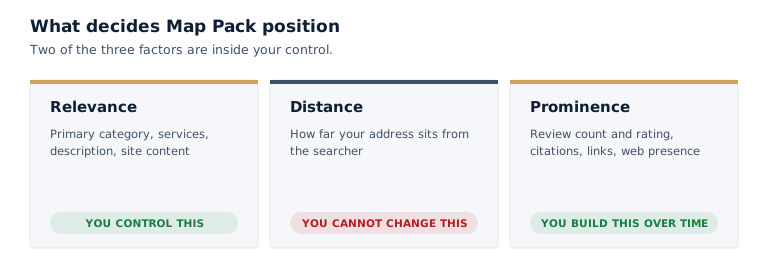
Google states that local rankings are determined by three factors, and understanding what each one means in practice tells you where effort pays off.
Relevance is how well your profile matches the search. This is driven by your primary category, your secondary categories, the services listed on your profile, your business description, and the content on your linked website. It is almost entirely within your control.
Distance is how far your listed address sits from the searcher or from the area they specified. You cannot change this short of opening another office, and it is the reason a firm can rank first from its own block and be invisible six miles away.
Prominence is how well known and well regarded your firm appears to be, measured through review count and rating, citation consistency across the web, links to your site, and general web presence. This compounds over time and is where sustained work produces durable advantage.
Building the Profile Correctly
A Google Business Profile has dozens of fields, and most law firm profiles have fewer than half of them filled in. Completeness itself is a signal.
Primary category
This matters more than anything else on the profile. Google offers granular legal categories — Personal Injury Attorney, Bankruptcy Attorney, Criminal Justice Attorney, Divorce Lawyer, Immigration Attorney, Estate Planning Attorney — and choosing the generic "Lawyer" category instead of the specific one is the most common self-inflicted wound in legal local SEO.
Choose the category that matches the cases you most want. Add secondary categories for genuine additional practice areas, but resist listing eight categories to cover everything; diluted relevance ranks worse than focused relevance.
Services, description, and attributes
List every service you offer as a distinct service entry with its own description. These entries give Google additional relevance signals and appear to searchers browsing your profile. Write the business description to describe what you do and who you serve in plain language, working in your practice area and geography naturally rather than stuffing keywords.
Fill in attributes honestly — wheelchair accessible, online appointments, languages spoken, veteran-owned where applicable. Language attributes in particular matter significantly for immigration and personal injury firms serving multilingual communities.
Photos and posts
Profiles with regular photo uploads and posts outperform dormant profiles. This is not because photos are magic; it is because activity signals an operating business. Upload office exterior and interior photos, team photos, and your logo. Publish posts weekly covering practice area explainers, firm updates, or answers to common client questions.
Your name, address, and phone number must match exactly everywhere they appear — your website, bar directories, Avvo, Justia, Yelp, and every legal directory. "Suite 400" on one and "Ste. 400" on another is a minor inconsistency; a legacy phone number on an old directory listing is a real problem. Audit and clean these before expecting Map Pack movement.
Reviews: The Compounding Asset
Review count, average rating, recency, and response rate all feed prominence. They also decide whether a searcher who sees you in the Map Pack actually calls. A firm ranking first with 6 reviews loses calls to the firm ranking third with 140.
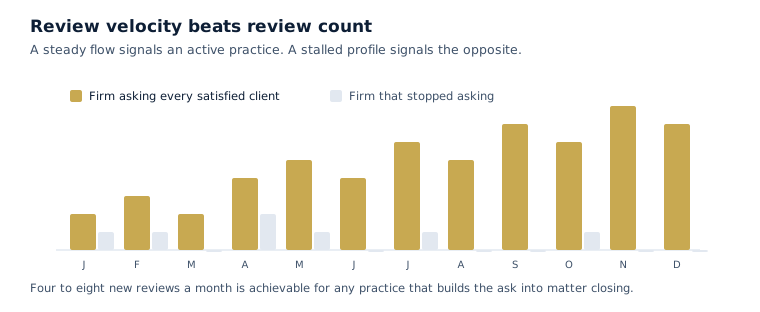
The mechanics that work are unglamorous. Ask every satisfied client, at the moment the matter concludes successfully, while the relief is fresh. Make it frictionless by sending the direct review link rather than instructing someone to search for you. Respond to every review, positive and negative, professionally and without disclosing confidential information. Maintain a steady cadence rather than soliciting thirty reviews in one week, which looks manufactured.
Do not buy reviews, do not offer anything of value in exchange for a review, and do not gate requests so that only happy clients are asked. These violate Google's policies and, in the case of incentives, may implicate bar rules on solicitation. Google has become aggressive about removing manufactured reviews, and a purge can erase years of accumulated rating overnight.
Responding to a negative review from a legal client requires particular care, since confidentiality restricts what you can say. A measured response that acknowledges the concern, states your commitment to client service, and invites offline discussion accomplishes the goal without disclosing anything protected.
See where your firm ranks across your whole city
We run a grid scan of your target keywords and show you the Map Pack position at every point in your service area — not just from your office.
Grid Tracking and Why Single-Point Rankings Lie
If you search your own keyword from your own office and see your firm in the Map Pack, that tells you almost nothing. Proximity is a ranking factor, so you will nearly always rank well from your own address. The question that matters is how far that visibility extends.
Grid tracking answers it by running the same search from dozens of simulated points across your service area and mapping the result. The output is a heatmap where each point shows your position — ones and twos in green, teens and twenties in red. It is the only honest picture of local visibility, and it usually surprises attorneys who believed they were ranking fine.
The strategic value is that the map shows you exactly where you are losing and to whom, which turns local SEO from guesswork into a targeted campaign.
Location Pages Done Right
Firms serving multiple cities often build location pages, and most do it badly — producing twenty near-identical pages with the city name swapped. Google recognizes this pattern as doorway pages and it can suppress the whole set.
A location page earns its place when it contains genuinely local substance: the specific courthouse that handles these matters and where it sits, local filing procedures or county-specific rules, neighborhoods and communities served, local case examples where permissible, and directions or parking guidance. If you cannot write three hundred words of genuinely city-specific material, that page should not exist.
| Approach | Outcome |
|---|---|
| One page per city, templated with name swapped | Doorway pattern; risks sitewide suppression |
| One page per city with real local content | Ranks; supports Map Pack relevance |
| One strong "Areas We Serve" hub + selective city pages | Safest structure for most firms |
| No location content at all | Caps reach at your immediate radius |
Multiple Offices and Service Areas
Each genuine office with its own staff and its own signage gets its own Google Business Profile. Virtual offices, mailbox addresses, and coworking desks used solely to create a listing violate Google's guidelines and risk suspension of the profile — sometimes along with your other listings.
Firms without a public office can operate as a service area business, hiding the street address and defining a served region. This is legitimate and appropriate for firms working by appointment, though service area businesses generally face a harder path to Map Pack prominence than firms with a verified physical location.
What Movement Actually Looks Like
Local SEO is faster than organic but it is not instant. A profile that has never been optimized typically shows changes in profile views and direction requests within two to six weeks of a thorough optimization. Position improvements in a moderately competitive market appear over sixty to ninety days. Top-three placement for a competitive term in a dense metro is usually a four to six month project, and holding it requires ongoing review acquisition and activity.
Firms that treat local SEO as a one-time setup lose position within a few quarters as competitors accumulate reviews and stay active. It is a maintenance channel, which is why our GBP management service is structured around weekly work rather than a single optimization pass.
Frequently Asked Questions
The Map Pack is the block of three local business listings that appears near the top of Google results for location-based searches like 'divorce lawyer near me.' It sits above traditional organic results and, on mobile, often fills the entire first screen. It is populated from Google Business Profiles and runs on a different algorithm than organic search, which is why a firm can rank well organically and be invisible in the Map Pack.
Claim and verify your Google Business Profile, choose the most specific legal category that matches the cases you want, complete every field including services and attributes, upload photos and post weekly, build review volume steadily with responses to each, and ensure your name, address, and phone number are identical across every directory listing. Proximity to the searcher is also a factor you cannot change, which is why visibility extends further in some directions than others.
There is no fixed threshold, because it is relative to your competitors in your market. Look at the three firms currently holding the Map Pack for your target keyword and treat their review counts as the benchmark. Recency and response rate matter alongside raw count, so a firm with 60 recent reviews and replies to all of them can outperform a firm with 200 reviews that stopped arriving two years ago.
Because distance from the searcher is one of Google's three local ranking factors. You will nearly always rank well from your own address and progressively worse as the searcher moves away. This is why grid tracking exists: it runs the same search from dozens of points across your service area and maps your position at each one, showing the true extent of your visibility rather than a flattering single-point result.
Yes, as a service area business. You hide the street address and define the region you serve. This is legitimate for firms operating by appointment. Service area businesses generally face a steeper climb to Map Pack prominence than firms with a verified physical office, so reviews and profile activity carry proportionally more weight.
Only when they contain genuinely local content. Templated pages with the city name swapped are recognized as doorway pages and can suppress your whole site. A location page earns rankings when it references the specific courthouse, county procedures, neighborhoods served, and other material that could only be written about that city. If you cannot write three hundred words of real local substance, do not publish the page.