"Spend five percent of revenue on marketing" is the most repeated and least useful piece of budget advice in the legal industry. It ignores case value, close rate, market cost, and practice area — the four variables that actually determine whether a dollar spent returns two dollars or zero.
This guide replaces that rule of thumb with arithmetic you can run on your own numbers in about fifteen minutes.
- Build the budget upward from case economics, not downward from a revenue percentage.
- The number that matters is cost per signed case, not cost per lead or cost per click.
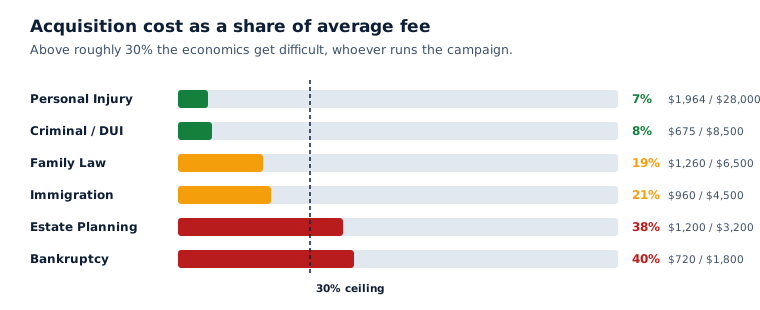
- Acquisition cost above roughly 25–30% of average fee is difficult to sustain in most practice areas.
- Close rate is usually cheaper to improve than lead cost, and firms ignore it.
- Budget for at least 90 days before judging any channel. Shorter windows measure noise.
The Only Calculation That Matters
Everything reduces to one chain. Work through it with your actual numbers.
Average fee per signed case
Total fee revenue over the last twelve months divided by matters signed. Use fees actually collected, not billed.
Lead-to-consultation rate
Of the inquiries you receive, what share actually schedule a consultation? Most firms overestimate this.
Consultation-to-retainer rate
Of consultations held, what share end with a signed fee agreement?
Leads required per signed case
Divide one by the product of steps 2 and 3. This is how many inquiries you need for one client.
Maximum viable cost per lead
Take your target acquisition cost as a share of average fee, then divide by leads required per case.
Average fee $6,500. Lead-to-consultation 45%. Consultation-to-retainer 40%. Leads per signed case: 1 ÷ (0.45 × 0.40) = 5.6. At a 20% acquisition target, allowable cost per case is $1,300, so maximum viable cost per lead is $1,300 ÷ 5.6 = $232. Family law leads in that market run $150–$300, so the channel is viable at the lower half of the range and marginal at the top.
Practice Area Benchmarks
These ranges are directional and vary substantially by market density. Use them to sanity-check your own numbers, not to replace them.
| Practice Area | Typical Avg Fee | Typical Lead Cost | Budget Pressure |
|---|---|---|---|
| Personal Injury | $25,000–$100,000+ | $200–$350 | Low — wide margin |
| Mass Tort | Highly variable | $300–$1,500+ | Variable |
| Criminal Defense / DUI | $5,000–$30,000 | $100–$200 | Low–Moderate |
| Family Law | $5,000–$25,000 | $150–$300 | Moderate |
| Immigration | $3,000–$15,000 | $150–$275 | Moderate |
| Estate Planning | $1,500–$10,000 | $175–$300 | High |
| Bankruptcy | $1,500–$10,000 | $150–$250 | High |
The pattern is clear: high-fee practices can absorb expensive leads and still profit comfortably. Low-fee, high-volume practices live or die on intake efficiency, because there is no margin to waste on slow callbacks.
Allocating Across Channels
Once you know what you can afford, the next question is where it goes. Allocation should follow practice area urgency and your firm's current position.
| Firm Situation | Suggested Emphasis |
|---|---|
| New firm, needs cases now | Paid search heavy; GBP setup concurrent; content later |
| Established, weak online presence | GBP and local SEO first — cheapest available lift |
| Good local presence, wants growth | Add paid search and content depth |
| Tight margins, strong intake | Pay-per-lead and Local Services Ads |
| Long horizon, building an asset | Content and SEO weighted; paid as supplement |
A common and reasonable starting split for a firm with budget across channels: the majority to the channel producing measurable cases today, a meaningful minority to local presence work that compounds, and a smaller allocation to content that pays off over quarters. Adjust monthly based on what actually signs.
Run these numbers with someone who has practiced
A free consultation to work through your case economics, your close rates, and what your market actually charges — before you spend anything.
Close Rate Is the Cheapest Lever
Firms obsess over lead cost and ignore close rate, which is backwards. Lead cost is set largely by the auction and your competitors. Close rate is entirely within your control.
Consider a firm converting 30% of consultations at a $250 lead cost. Moving to 40% — achievable through faster callbacks, better consultation structure, and disciplined follow-up — reduces cost per signed case by a quarter without touching the ad budget. Getting a comparable reduction by lowering lead cost would require outcompeting every other firm in the auction.
The specific improvements that move close rate: responding within minutes rather than hours, following up at least three to five times rather than once, offering same-day or next-day consultations, and using a consistent consultation structure that ends with a clear ask rather than "let me know what you decide."
Budget for a Real Test Window
Ninety days is the minimum honest window for judging most channels. Paid search needs sixty days of conversion data before automated bidding stabilizes. Local SEO shows early signal in weeks but meaningful position change over two to three months. Content is a six to twelve month proposition.
Firms that cancel at day thirty are paying the full cost of the learning period and capturing none of the return. If you cannot fund ninety days of a channel, do not start it — put the money into a channel you can fund properly.
What to Track Monthly
A one-page monthly review covering six numbers will tell you more than any dashboard: total marketing spend, qualified leads received, consultations held, cases signed, cost per signed case, and average fee per signed case.
Record the source of every new matter at intake. That single discipline — asking every new client how they found you and writing it down — reveals more about channel performance than most analytics configurations, and it costs nothing.
When to Scale and When to Cut
The hardest budget decisions are not the initial ones. They are whether to put more money into something that is working and whether to stop something that is not.
Scale when three conditions hold together: cost per signed case has been stable or improving for at least sixty days, your intake team has genuine capacity for more volume, and the channel has not shown signs of saturation such as rising costs at flat volume. Scale in increments of twenty to thirty percent rather than doubling, and hold the new level long enough to see whether efficiency survives the increase.
Cut when cost per signed case exceeds your ceiling for two consecutive months after genuine optimization attempts, when lead quality has degraded in a way you can document rather than sense, or when the channel is consuming management attention disproportionate to what it returns.
Resist cutting for the wrong reasons. A single bad month is noise. A channel that has not had ninety days has not been tested. And a channel producing cases you dislike is usually a targeting problem rather than a channel problem.
The Costs Firms Forget
Budgets built purely around ad spend understate the real number, sometimes badly.
Beyond media cost, a complete marketing budget accounts for agency or management fees, call tracking and software subscriptions, website hosting and maintenance, content production whether internal time or external cost, and the staff time consumed by intake. That last one is the most commonly omitted and frequently the largest: if answering and working leads occupies twenty hours a week of a paralegal's time, that is a real marketing cost even though it never appears on an invoice.
Including these produces a truer cost per signed case and occasionally reveals that a channel which looked marginally profitable on media cost alone is actually losing money once the labor to work it is counted.
Seasonality and Cash Flow
Legal demand is not flat across the year, and budgets set as a fixed monthly number ignore predictable swings that a firm could be exploiting.
The patterns are reasonably consistent by practice area. Family law inquiries typically rise in January and again after summer. Bankruptcy filings often climb in the months following the holidays and around tax season as refunds fail to close the gap. DUI volume spikes around holiday weekends. Estate planning interest rises at year end and after publicized events that prompt people to think about their affairs.
Firms that shift budget toward high-demand periods rather than spending evenly capture more cases for the same annual spend. The mechanism is simply that intent is higher, so the same click converts more often.
Cash flow deserves separate attention in contingency practices, where marketing is paid monthly but fees arrive when cases resolve, sometimes years later. Budgeting on collections received rather than cases signed avoids a squeeze that catches growing personal injury firms off guard.
Frequently Asked Questions
Derive it from case economics rather than a revenue percentage. Calculate your average fee per signed case, your lead-to-consultation rate, and your consultation-to-retainer rate. That tells you how many leads a case requires and what you can afford per lead at your target acquisition cost. A firm averaging $28,000 per case and one averaging $1,800 should have very different budgets, and no percentage rule captures that.
As a share of average fee, acquisition costs above roughly 25 to 30 percent become difficult to sustain in most practice areas once overhead is accounted for. Personal injury firms frequently operate in the 5 to 10 percent range because case values are high. Bankruptcy and estate planning firms often run 25 to 40 percent, which is why intake efficiency matters disproportionately in those practices.
Ninety days is the minimum honest evaluation window. Paid search produces calls within days but needs about 60 days of conversion data before bidding stabilizes. Local SEO shows early signal in two to six weeks with meaningful position change over two to three months. Content is a six to twelve month investment. Firms that cancel at day 30 pay for the learning period and capture none of the return.
Close rate, almost always. Lead cost is set largely by the auction and your competitors, while close rate is entirely within your control. A firm moving from 30 to 40 percent consultation conversion cuts cost per signed case by a quarter with no change in ad spend. Achieving the same result by lowering lead cost would require outbidding every competitor in the market.
The commonly cited two to ten percent range is a poor guide because it ignores the variables that matter: case value, close rate, market cost, and practice area. A better approach is to calculate your maximum viable cost per lead from case economics, compare it to actual lead prices in your market, and set the budget from how many cases you want and can service.
Use call tracking with a distinct number per channel and dynamic number insertion on the website, so calls are attributed to source. Beyond that, record the source of every new matter at intake by asking each new client how they found you and writing it down. Reviewing that monthly against spend reveals more than most analytics setups.