Most law firm content fails for one reason: it was written to exist rather than to answer anything. Five hundred words on "The Importance of Hiring an Experienced Attorney" ranks for nothing, helps nobody, and quietly signals to Google that the site produces filler.
Content that works in legal is content that answers a specific question a worried person actually typed, with the specificity only a practicing attorney can provide. This guide covers how to find those questions, how to structure the answers, and how to build a library that compounds.
- Write to the question, not to the keyword. The question is what people type and what AI systems retrieve.
- Your consultation notes are the best keyword research tool you own.
- Depth beats frequency. Twelve substantial pages outperform fifty thin ones.
- Topic clusters — a pillar page plus supporting articles — build authority faster than scattered posts.
- Every piece needs a named attorney author. Expertise signals carry disproportionate weight on legal topics.
Your Best Keyword Research Is in Your Consultations
Keyword tools tell you search volume. They do not tell you what a frightened person actually needs to know. You already have that data, in every consultation you have ever conducted.
The questions clients ask before they hire you are, almost without exception, the questions thousands of other people are typing into Google right now. "Will I lose my house?" "Can they garnish my wages?" "How long will this take?" "Will my ex find out I contacted a lawyer?" Each of those is a page.
A practical exercise: for the next ten consultations, write down every question asked before the fee agreement. You will have thirty to fifty questions, most of them with real search volume and almost none of them covered on your current site.
Content Types That Perform
| Type | Purpose | Typical Length |
|---|---|---|
| Practice area pillar page | Rank for the head term; anchor the cluster | 1,500–3,000 words |
| Question-driven article | Capture long-tail intent; feed AI answers | 800–1,500 words |
| Process explainer | Set expectations; reduce consultation friction | 1,000–2,000 words |
| Jurisdiction guide | Capture local intent with real local substance | 800–1,500 words |
| Cost / fee explainer | High commercial intent; pre-qualifies leads | 800–1,500 words |
| Generic "tips" listicle | Ranks poorly; signals filler | Skip |
Topic Clusters Beat Scattered Posts
Publishing unrelated articles produces unrelated results. The structure that builds authority is the cluster: one comprehensive pillar page on a core topic, surrounded by supporting articles that each go deep on one sub-question, with every supporting article linking to the pillar and the pillar linking back.
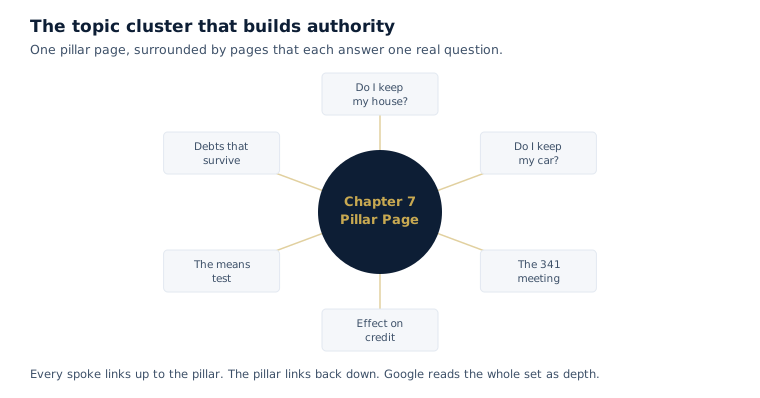
A bankruptcy cluster might have a pillar page on Chapter 7 bankruptcy in your state, supported by articles on whether you keep your house, whether you keep your car, what the 341 meeting is like, how bankruptcy affects credit, the means test, and what debts survive discharge. Each supporting article ranks for its own long-tail query, and collectively they signal to Google that the pillar page is backed by genuine topical depth.
This structure also happens to be what AI systems retrieve well, because each supporting page answers one question cleanly.
How to Write It
Answer in the first two sentences
Do not build up to the answer. State it, then explain. Readers scanning on a phone and AI systems extracting an answer both reward this.
Be specific and jurisdictional
"In California, the vehicle exemption under CCP 704.010 currently protects a set amount of equity" is useful. "Exemption amounts vary" is not. Specificity is what only an attorney can supply.
Write the way you speak in a consultation
Plain language, no legalese, no throat-clearing. If you would not say it to a client across a desk, do not publish it.
Use question-shaped headings
Headings that mirror real queries make the page scannable and map directly to how people and machines search.
Attribute it to a real attorney
A named author with bar admissions and a linked bio page is a meaningful trust signal on legal content, for both Google and AI retrieval.
We build content libraries for law firms
Practice area pillars, question-driven clusters, and jurisdiction pages — written to rank, structured to be cited, and compliant by default.
Content and Bar Rules
Substantive legal content sits close to the line between education and legal advice, and bar rules apply.
Include a disclaimer that the content is general information and not legal advice, and that reading it creates no attorney-client relationship. Avoid stating or implying guaranteed outcomes. Present case results, where you use them, with the disclaimers your state requires. And be careful with content addressing jurisdictions where you are not admitted — several states treat that as a potential unauthorized practice issue depending on how it is framed.
Our compliance guide covers the details.
Cadence and Maintenance
Frequency matters far less than firms expect. Two genuinely substantial pieces a month will outperform eight thin ones, and will not train Google to view your site as a filler farm.
Maintenance matters more than most firms realize. Legal content goes stale: exemption amounts change, procedures get amended, filing fees rise. A page with outdated figures damages credibility with clients and can be actively harmful. Review your top-performing content at least annually, update figures and citations, and refresh the modified date honestly.
Measuring Content
Judge content the way you judge everything else in legal marketing: by cases, not sessions.
The useful measurements are which pages produce calls and form submissions, which pages rank for terms with commercial intent, which pages get cited in AI answers, and which pages get referenced by prospective clients during consultations. That last one is qualitative and undervalued — when a client says "I read your page about the means test," that page is working regardless of what analytics shows.
Beyond Written Pages
Written content remains the foundation, but several other formats earn their place in a legal content program, and most firms underuse them.
Short video answering a single client question performs well because prospective clients want to see the attorney before they call. A two-minute video of you explaining what happens at a 341 meeting, embedded on the page that covers the same topic, increases time on page and gives people the familiarity that drives a call. It need not be professionally produced — a clear phone recording in decent light is sufficient and often more trustworthy than polished production.
FAQ sections on practice area pages do double duty: they answer real questions for readers, and marked up with FAQPage schema they become eligible for rich results and are readily extracted by AI systems.
Downloadable checklists and process guides work as genuine utilities — a document checklist for a bankruptcy filing, a list of what to bring to an initial divorce consultation. They serve prospective clients and reduce friction in your own intake.
Repurposing Across Channels
A single substantive piece of content should not be published once and abandoned. The same underlying material can become a page on your site, a Google Business Profile post, a short video, a social post, and an answer you reuse in consultations.
This matters practically because the constraint on legal content is almost never ideas — it is attorney time. Recording one ten-minute explanation of a topic you have explained a hundred times produces a page, a video, and several weeks of posts. That is a far more realistic operating model for a practicing attorney than committing to write two articles a month.
Record yourself answering the question as you would in a consultation. Have it transcribed. Have a writer structure the transcript into a publishable page with proper headings and links. You supply the substance, which is the part only you can provide, and skip the drafting, which is the part that never gets done.
Internal Linking and Site Architecture
Content published without a linking strategy sits in isolation and underperforms regardless of quality. Internal links are how you pass authority between pages and how you signal which pages matter most.
The working rules are straightforward. Every supporting article links up to its pillar page using descriptive anchor text that reflects the target page's topic. Every pillar page links down to its supporting articles. Related articles across a cluster link to each other where the connection is genuinely useful to a reader. And your highest-value commercial pages — the practice area pages that convert — should receive the most internal links, because that is how you tell Google what your site is actually about.
Avoid the common failure of linking everything to everything. Links that do not serve a reader dilute the signal. A link belongs where a reader would plausibly want to follow it.
Auditing What You Already Published
Most firms with an existing blog have a library of underperforming posts they have never reviewed. That archive is usually a bigger opportunity than new publishing.
Work through it once. Pages that rank and convert get updated and expanded. Pages covering a worthwhile topic badly get rewritten properly. Pages that are thin filler on topics you will never own get consolidated into a stronger page or removed entirely, with redirects where they have any inbound links. Removing genuinely worthless content can lift the performance of what remains.
Frequently Asked Questions
Content that answers specific questions prospective clients search absolutely helps. Content written to hit a publishing quota does not, and can hurt by signaling to Google that your site produces filler. The difference is whether the page answers something real. 'What happens to my car if I file Chapter 7 in California' works; 'Five Tips for Choosing a Lawyer' does not.
Two substantial pieces a month outperforms eight thin ones. Frequency matters far less than depth and specificity. A firm that publishes one genuinely excellent 2,000-word answer to a question clients actually ask will see better results than one publishing weekly filler.
The questions clients ask in consultations before they hire you. Those questions have real search volume because thousands of people with the same problem are typing them into Google. Write down every question asked across your next ten consultations and you will have thirty to fifty content topics, most with no good answer currently ranking.
Practice area pillar pages generally need 1,500 to 3,000 words to compete. Question-driven articles work at 800 to 1,500 words. The length should be whatever fully answers the question and no more. Padding to hit a word count produces exactly the kind of content Google's helpful content systems are designed to suppress.
The specificity that makes legal content rank generally requires an attorney's knowledge. A practical model is for the attorney to record a ten-minute explanation of the topic as they would give it to a client, and have a writer structure it into a publishable page. That preserves the substance while removing the drafting burden.
Yes. Include a statement that the content is general information rather than legal advice and that reading it creates no attorney-client relationship. Avoid implying guaranteed outcomes, and present any case results with the disclaimers your state bar requires. Be cautious about content addressing jurisdictions where you are not admitted.