A growing share of people looking for a lawyer no longer start at Google. They open ChatGPT, Claude, Perplexity, or Google's own AI Overviews and ask a question in plain language: "I got rear-ended in Pasadena and the other driver has no insurance — what do I do and who should I call?"
The answer they receive names a handful of firms, or names none at all. Whether your firm appears in that answer is now a distinct marketing discipline. It overlaps with traditional SEO but is not the same thing, and most law firms have done nothing about it.
- AI systems cite sources that answer questions directly, cleanly structured and clearly attributed. Sales copy does not get cited.
- Entity clarity matters more than keyword density. The model needs to know who you are, where you practice, and what you do.
- Your Google Business Profile and third-party mentions feed AI answers, not just your website.
- An llms.txt file gives AI systems a clean, structured summary of your firm.
- You cannot buy placement in AI answers. You earn it by being the clearest available source.
How AI Systems Decide Who to Name
Large language models answer legal questions in two ways. Some rely on what they absorbed during training — a static picture of the web as of a particular date. Others perform a live search, retrieve pages, and synthesize an answer from what they find, citing sources as they go. Increasingly, the major systems do both.
In either mode, the same underlying property determines whether your firm is mentioned: is your content the clearest, most directly useful answer available on the specific question being asked? Models do not reward the page with the most backlinks or the most aggressive optimization. They reward the page that most efficiently resolves the question.
This is genuinely good news for smaller firms. A solo attorney who writes the single best explanation of Chapter 13 plan confirmation in California can be cited over a national firm with a thousand backlinks and a thin page on the same topic.
Structuring Content for Retrieval
AI systems parse structure. Content organized in a way that makes the answer easy to locate and extract gets cited far more often than equally accurate content buried in prose.
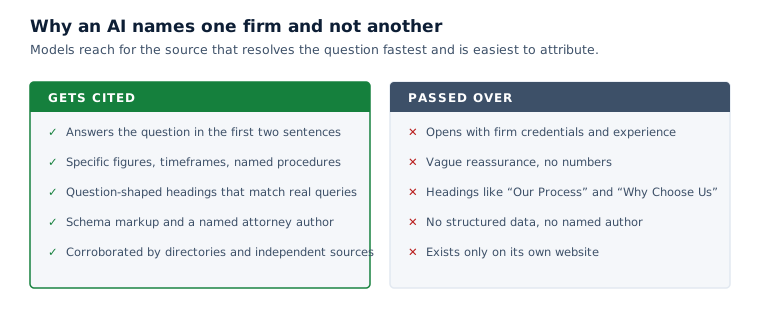
Lead with the answer
Put the direct answer in the first two sentences under the heading, then expand. Models extract the opening of a section far more readily than a conclusion buried at the bottom.
Use question-shaped headings
A heading that reads "How long does a Chapter 7 bankruptcy take in California?" maps directly to a user query. A heading that reads "Our Process" maps to nothing.
Be specific and quantified
Numbers, timeframes, dollar ranges, and named procedures get cited. Vague reassurance does not. "Typically 90 to 120 days" is citable; "a relatively short process" is not.
Mark it up with schema
FAQPage, Article, LegalService, and Organization schema give machines an unambiguous reading of what the page contains and who published it. Structured data is how you remove interpretation from the equation.
Attribute authorship clearly
A named attorney author with credentials, bar admission, and a real bio page establishes the expertise signal that both Google's systems and AI retrieval weigh heavily on legal topics.
Entity Clarity: Teaching Machines Who You Are
Before a model can recommend your firm, it needs an unambiguous understanding of what your firm is. That understanding is built from consistent signals across the web, not from your website alone.
The components are straightforward. Your firm name, address, and phone number should be identical everywhere they appear. Your practice areas should be stated the same way on your site, your Google Business Profile, and every directory. Your attorneys should have real bio pages with bar numbers, admissions, education, and areas of practice. Organization and LegalService schema on your site should state all of this in machine-readable form.
Where this diverges from traditional SEO is emphasis. Keyword optimization is about matching a query string. Entity optimization is about being unmistakable — so that when a model assembles an answer about bankruptcy attorneys in Beverly Hills, your firm is a clearly defined node it can reach for rather than an ambiguous set of conflicting mentions.
AI systems weight independent corroboration heavily. Bar association directories, legal directories, local news coverage, podcast appearances, and citations in other people's content all reinforce the entity. A firm that exists only on its own website is a weaker entity than one referenced across a dozen independent sources.
The llms.txt File
A convention has emerged for giving AI systems a clean, structured summary of a site: a plain-text file at /llms.txt that states who you are, what you do, where you operate, and which pages contain your substantive content.
It functions loosely the way robots.txt does for crawlers — a machine-readable orientation file. It is not yet a formal standard and not every system reads it, but it costs nothing to publish, it removes ambiguity about your firm, and adoption among AI platforms is increasing.
A useful llms.txt for a law firm states the firm name and location, practice areas served, the attorney's credentials and background, key service pages with one-line descriptions, and contact information. Attorney Pro Marketing publishes one at /llms.txt.
Is your firm showing up in AI answers?
Our audit includes checking how ChatGPT, Claude, and Perplexity currently describe your firm and your market — and what it would take to be cited.
Where AI Optimization Differs From SEO
| Dimension | Traditional SEO | AI Search Optimization |
|---|---|---|
| Unit of success | Ranking position | Being named or cited in an answer |
| Primary lever | Authority & backlinks | Clarity & direct answers |
| Content shape | Comprehensive pages | Extractable, question-shaped sections |
| Keyword role | Match the query string | Match the underlying intent |
| Structured data | Helpful for rich results | Close to essential |
| Third-party mentions | Valuable as links | Valuable as corroboration, link or not |
| Measurement | Rank trackers, Search Console | Manual prompting & mention tracking |
The overlap is substantial — a well-built page tends to perform in both — but the emphasis differs enough that a firm optimizing purely for rankings will underperform in AI answers relative to a firm writing for clarity.
Measuring AI Visibility
There is no Search Console for AI answers yet, so measurement is more manual than attorneys are used to.
The practical method is to build a list of twenty to thirty prompts a real prospective client might use — "best bankruptcy attorney in Beverly Hills," "what happens if I file Chapter 7 in Los Angeles," "do I need a lawyer for a DUI in California" — and run them across the major systems on a monthly cadence, recording whether your firm is mentioned and how it is characterized.
Beyond mentions, check analytics for referral traffic from AI platforms, which many systems now pass. And run a direct test: ask each system what it knows about your firm by name. The answer reveals exactly how clearly your entity is understood, and whether anything inaccurate has attached to it.
If a model describes your firm incorrectly — wrong practice area, outdated address, a merged identity with a similarly named firm — the fix is upstream. Correct the source data across your site, your Google Business Profile, and every directory listing, then wait for re-crawling. There is no support line for correcting a model's understanding, so entity consistency is the only lever.
Where to Start
For a firm that has done nothing here, the sequence that produces the fastest improvement is straightforward. Begin by auditing what the major systems currently say about your firm and your core practice area, so you know your starting position. Then fix entity consistency everywhere your firm appears. Add comprehensive schema to your site. Restructure your highest-value practice area pages to lead with direct answers under question-shaped headings. Publish an llms.txt. Then build question-driven content around the questions clients actually ask, which is covered in our content marketing guide.
None of this conflicts with traditional SEO work. Clear, well-structured, authoritatively attributed content ranks better in Google as well. The firms that win the next several years will be the ones that stopped writing for algorithms and started writing the way they talk to clients.
Frequently Asked Questions
It is the practice of structuring your firm's online presence so that AI systems like ChatGPT, Claude, Perplexity, and Google AI Overviews name and cite your firm when someone asks a legal question in plain language. It overlaps with traditional SEO but emphasizes direct answers, structured data, clear entity definition, and third-party corroboration rather than rankings and backlinks.
No. There is no advertising inventory in AI-generated answers from the major assistants, and no vendor can sell you placement. Citation is earned by being the clearest and most directly useful source on the specific question being asked. Any agency claiming it can buy your firm into AI answers is selling something that does not exist.
No, it extends it. The two disciplines overlap substantially, and content built to be clear and well-structured performs in both. The difference is emphasis: traditional SEO weights authority and backlinks, while AI retrieval weights clarity, specificity, and entity consistency. A firm should do both rather than choosing between them.
It is a plain-text file placed at the root of a website that gives AI systems a structured summary of the organization: who it is, what it does, where it operates, and which pages contain substantive content. It works loosely the way robots.txt works for crawlers. It is an emerging convention rather than a formal standard, but it costs nothing to publish and removes ambiguity about your firm.
Build a list of 20 to 30 prompts a real prospective client might use, run them across ChatGPT, Claude, Perplexity, and Google AI Overviews monthly, and record whether your firm appears and how it is described. Also check your analytics for referral traffic from AI platforms, and ask each system directly what it knows about your firm by name to see how clearly your entity is understood.
Because that firm's content answers the specific question more directly and is easier to extract and attribute. Models favor sources that lead with a clear answer, use specific figures and timeframes, carry structured data, name a credentialed author, and are corroborated by independent mentions across directories and news. Marketing language and service descriptions get passed over in favor of substantive explanation.
Answer engine optimization, often shortened to AEO and sometimes called generative engine optimization or GEO, is the practice of structuring content so that AI assistants and AI-generated search summaries can find, understand and cite it. It overlaps heavily with good SEO — clear factual content, structured data, consistent business information — but optimises for being quoted in an answer rather than for a position in a list of links. Nobody can buy placement in an AI answer, and any vendor offering it is selling something they cannot deliver.
There is no submission process and no paid placement. What appears to help is being clearly and consistently described across the sources these systems draw on: a site that answers real questions directly rather than in marketing language, accurate and consistent business information everywhere your firm is listed, structured data that states plainly who you are and what you do, and third-party sources that corroborate it. Treat it as earning a citation rather than buying a slot.
Write pages that answer a specific question completely and early, in language a system can extract without interpretation; mark the questions up as structured data; keep facts consistent between your site, your Google Business Profile and directory listings; and make sure the claims are verifiable, since systems favour content they can corroborate. Pages built to rank by length rather than by answering tend not to be cited, because there is no extractable answer in them.
It is reducing clicks on some searches, though the honest picture is narrower than the headlines. Pew Research analysed the browsing of 900 US adults in March 2025 and found that 18% of Google searches produced an AI summary, and that users who saw one clicked a traditional result on 8% of visits against 15% when no summary appeared. Only about 1% clicked a link inside the summary. For law firms the practical response is to make sure the traffic you do get converts, and to be the source the summary draws on — not to assume either collapse or business as usual.