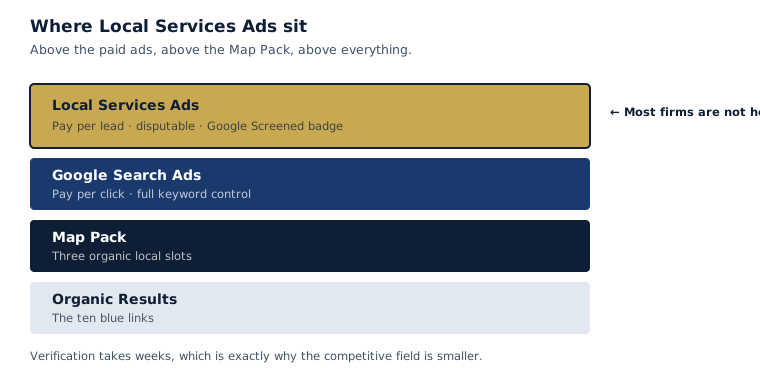
Above the Google Ads, above the Map Pack, above everything else on a local legal search sits a block of listings with a green checkmark reading Google Screened. These are Local Services Ads, and they operate on entirely different rules from the rest of Google advertising.
You pay per lead rather than per click. You cannot choose keywords. You must pass a background check and bar verification to participate at all. For firms that qualify, LSAs frequently deliver the lowest cost per acquisition available in legal advertising.
- LSAs appear above every other paid and organic result, including the Map Pack.
- You pay per lead, not per click — and you can dispute leads that do not qualify.
- The Google Screened badge requires background checks, license verification, and insurance.
- You cannot select keywords. Google matches you based on your listed services and location.
- Responsiveness affects your ranking. Missed calls push you down the rotation.
What Local Services Ads Are
Local Services Ads were built for service businesses where trust is the deciding factor and verification matters — locksmiths, electricians, and, since Google opened the category to legal, attorneys.
The format is deliberately simple: firm name, star rating and review count, years in business, a Google Screened badge, and a call or message button. There is no headline to write, no description to optimize, no landing page to design. Google assembles the ad from your verified profile.
That simplicity is the point. A prospective client scanning results sees a verified, reviewed, licensed attorney with a button that dials directly. The friction between search and phone call collapses to a single tap.
| Local Services Ads | Google Search Ads | |
|---|---|---|
| Position on page | Very top, above all | Below LSAs |
| Pricing model | Per lead | Per click |
| Keyword control | None | Full |
| Verification required | Background check, license, insurance | None |
| Landing page needed | No | Yes |
| Bad leads | Disputable for credit | Paid regardless |
| Ad copy control | None | Full |
| Scale ceiling | Limited inventory | High |
Qualifying for Google Screened
The verification process is the barrier, and it is also the moat. Firms that complete it face a materially smaller competitive field than they do in the open search auction.
License verification
Google verifies that every attorney listed holds an active bar license in good standing in the state where the firm advertises. Disciplinary history can affect eligibility.
Background checks
Conducted through a third-party provider on the business and, in most cases, on individual attorneys. This typically takes several days to a few weeks.
Insurance verification
Proof of professional liability coverage at Google's required minimums for the category.
Business registration
Confirmation the entity is properly registered and that the business details match public records.
Google's legal LSA categories and geographic availability have expanded over time but remain uneven. Personal injury, criminal defense, family law, immigration, bankruptcy, estate planning, and employment law are commonly supported in major U.S. markets. Confirm availability for your practice area and state before planning around it.
How Google Ranks LSA Listings
Because there are no keywords and no bids in the traditional sense, ranking is driven by a different set of inputs — and several of them are operational rather than advertising decisions.
Proximity to the searcher matters, as it does in the Map Pack. Review score and volume within Local Services Ads matter, and these are partly distinct from your Google Business Profile reviews. Your responsiveness matters significantly: Google tracks whether you answer calls, and firms that miss calls get shown less. Your weekly budget influences how often you enter the rotation. And your business hours matter, since Google preferentially shows firms currently able to answer.
A missed LSA call costs you the case and lowers your future visibility. If you cannot staff the phone reliably, LSAs will underperform regardless of budget. For criminal defense and personal injury, an after-hours answering service that takes real information is effectively mandatory.
Lead Pricing and Disputes
LSA lead costs for legal categories vary widely by market and practice area, generally running from roughly $30 to well over $250 per lead. Personal injury in a dense metro sits at the top of that range; estate planning in a mid-size market sits near the bottom.
The meaningful advantage over search ads is the dispute process. You are charged for a lead, not a click, and you can request credit for leads that do not qualify — wrong practice area, outside your service area, spam, a job inquiry, a solicitation, or an existing client. Google reviews the call recording and credits legitimate disputes.
Firms that review and dispute consistently often reduce effective cost per lead by a meaningful margin. Firms that never dispute pay for every wrong number.
Not sure whether LSAs make sense for your firm?
Our free audit covers whether your practice area and market support Local Services Ads, what leads cost locally, and how it compares to search ads for your case economics.
Reviews Inside the LSA System
Local Services Ads carry their own review mechanism. Google sends review requests to leads that came through the platform, and those reviews display on your LSA listing alongside your broader Google rating.
The practical implication is that you should ask LSA-sourced clients specifically to leave a review through the link Google sends, in addition to your normal Google Business Profile review process. Review score influences LSA ranking, and a firm with few LSA reviews competes at a disadvantage against one with many.
Who LSAs Work Best For
LSAs perform strongest for firms with reliable phone coverage, since responsiveness is a ranking input and every lead arrives as a call. They suit firms in verticals where the Google Screened badge carries weight — criminal defense and personal injury clients are making a high-stakes trust decision under pressure. They work well for firms in markets where search ad CPCs have become punishing, because per-lead pricing can undercut per-click pricing substantially.
They work less well as a sole channel. Inventory is limited, you cannot control which queries trigger your listing, and there is no way to scale aggressively the way you can with a search campaign. The correct mental model is a high-efficiency supplement that sits alongside search ads and Map Pack visibility, not a replacement for either.
Setting Up Correctly
A few configuration decisions disproportionately affect performance. Select only the service categories you genuinely want cases in — listing everything generates leads you will dispute or decline. Set your service area to match where you can actually practice and want to travel, not the largest region available. Set business hours honestly, since Google favors firms that are open. Set a weekly budget that reflects real intake capacity rather than aspiration.
Then monitor the lead log weekly, dispute what does not qualify, and adjust categories based on which produce signed cases rather than which produce volume.
Running LSAs Alongside Search Ads and Map Pack
The three placements stack vertically on the same page, and a firm appearing in all three occupies a disproportionate share of the first screen. That is the strategic objective — not choosing between them.
Each contributes something the others cannot. Local Services Ads deliver verified-badge credibility and per-lead pricing with dispute rights, but you cannot control which queries trigger them and inventory is capped. Search ads give you complete keyword and message control with effectively unlimited scale, at per-click pricing and no dispute mechanism. Map Pack placement is unpaid and compounds over time, but moves slowly and is constrained by proximity.
A practical sequence for a firm building from nothing: start LSA verification immediately since it takes weeks to clear, launch search ads for the queries you most want while verification runs, and begin Google Business Profile work in parallel because it costs little and compounds. Within a quarter you are competing in all three zones.
Budget Pacing and Weekly Caps
LSA budgets are set weekly rather than daily, and Google spends against that budget by showing your listing in rotation. Setting the cap too low means you drop out of rotation early in the week and miss volume on the days that matter.
Set the weekly budget from intake capacity rather than ambition — the number of new matters your team can genuinely work this week, multiplied by leads required per signed case, multiplied by your local lead cost. Then watch the pacing. A budget consistently exhausted by Wednesday is either too low or is being consumed by leads in categories you should not have selected.
Tracking LSA Performance Honestly
Local Services Ads report inside their own dashboard rather than alongside your search campaigns, which makes it easy to evaluate them in isolation and reach the wrong conclusion.
The number that matters is the same as everywhere else: cost per signed case. Pull your LSA lead count and spend, apply your actual conversion rate from LSA leads specifically — which often differs from your search ad conversion rate because the lead arrives as a phone call from someone who already saw a verification badge — and compare the result against your other channels on identical terms.
Review the lead log weekly rather than monthly. Recordings are retained for a limited window, and disputes filed late are harder to substantiate. A weekly ten-minute pass through the log listening to anything marked as a booked lead you do not recognize will recover more money than most optimization work.
Frequently Asked Questions
Local Services Ads are a Google advertising format that appears above all other paid and organic results, including the Map Pack. They display your firm name, star rating, years in business, and a Google Screened badge with a direct call button. You pay per lead rather than per click, and participation requires passing background checks, license verification, and insurance verification.
Lead costs vary substantially by practice area and market, generally ranging from about $30 to over $250 per lead. Personal injury in a major metro sits at the high end; estate planning in a mid-size market sits at the low end. Because you can dispute leads that do not qualify, the effective cost is often meaningfully lower than the headline rate for firms that review their lead log consistently.
It is a verification badge Google awards to professional service providers who pass license verification, background checks, and insurance verification. For law firms it confirms active bar licensure in good standing. The badge appears prominently on your Local Services Ad and functions as a trust signal for clients making a high-stakes decision under pressure.
Yes, and you should. Leads that fall outside your practice area or service area, spam calls, job inquiries, solicitations, and calls from existing clients can all be disputed for credit. Google reviews the call recording and issues credits for legitimate disputes. Firms that review their lead log weekly and dispute consistently reduce effective cost per lead noticeably.
No. LSA inventory is limited and you cannot control which queries trigger your listing, so it cannot scale the way a search campaign can. The right model is a high-efficiency supplement running alongside search ads and Map Pack visibility. Many firms find LSAs deliver their lowest cost per acquisition while search ads deliver the volume.
The most common causes are budget exhaustion for the week, business hours set to closed, a lapse in insurance or license verification, or declining responsiveness. Google tracks whether you answer calls and reduces visibility for firms that miss them. Check your verification status, hours, budget pacing, and answered-call rate in that order.