Reviews decide two things for a law firm simultaneously: whether Google shows you in the Map Pack, and whether the person who sees you there actually calls. A firm ranking first with eight reviews loses to the firm ranking third with a hundred and forty.
Legal reviews carry complications other industries do not face. Confidentiality restricts what you can say in a response. Bar rules restrict what you can offer in exchange. And the emotional stakes of legal matters mean negative reviews arrive with more heat than a bad restaurant review.
- Review count, rating, recency, and response rate all feed local ranking.
- Ask at the moment of resolution, when relief is fresh, and make it a single tap.
- Never offer anything of value for a review. It violates platform policy and may implicate bar rules.
- Responding to a negative review requires care — confidentiality survives the end of representation.
- Steady cadence beats bursts. Thirty reviews in a week reads as manufactured.
Why Reviews Carry So Much Weight in Legal
Hiring an attorney is a high-stakes, low-information decision. A prospective client cannot evaluate your legal skill, cannot compare outcomes meaningfully, and is often making the decision under stress. Reviews become the available proxy for competence.
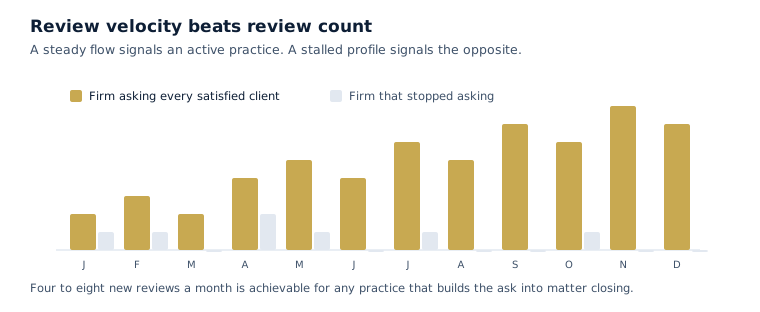
Google reads the same signal. Review volume and rating feed the prominence factor in local ranking, and recency matters — a firm with two hundred reviews that stopped arriving three years ago is weaker than a firm with eighty that arrive steadily.
Asking Correctly
Most firms fail at reviews because they never ask, or ask at the wrong moment, or make it too hard.
Ask at resolution
The moment a matter concludes well is the moment gratitude peaks. A discharge order, a favorable settlement, a dismissal — that day, not three weeks later.
Make it one tap
Send the direct Google review link by text. Telling someone to "look us up and leave a review" loses most of them at the search step.
Ask personally
A request from the attorney who handled the matter converts far better than an automated email from the firm. Where possible, ask verbally first and follow with the link.
Build it into the closing process
Make the request a standard step in matter closure rather than something someone remembers to do. Consistency is what produces a steady cadence.
Do not offer fee discounts, gift cards, or anything of value in exchange for a review — this violates Google's policies and may implicate bar rules on solicitation and on false or misleading communications. Do not write reviews for clients. Do not have staff or family post reviews. Do not gate requests so only satisfied clients are asked; several platforms prohibit review gating outright.
Responding Without Breaching Confidentiality
This is where legal diverges sharply from every other industry. A restaurant can reply to a complaint by discussing what happened that night. An attorney generally cannot confirm that a person was a client, let alone discuss the representation.
The duty of confidentiality survives the end of representation, and several state bars have disciplined attorneys for disclosing client information in review responses — including attorneys who were factually correct and responding to unfair criticism.
A safe response to a negative review acknowledges that the reviewer had a poor experience, states the firm's commitment to client service, and invites direct contact offline. It does not confirm or deny representation, does not describe the matter, and does not correct the record publicly.
"We take feedback seriously and hold ourselves to a high standard in every matter we handle. Professional obligations limit what we can discuss publicly about any individual's situation. If you would like to speak with us directly, please call our office at (310) 496-7306 and ask for Alon."
Responses to positive reviews are simpler but still warrant care. Thank the reviewer, keep it brief and specific to what they praised, and avoid confirming case details or outcomes. "Thank you — we're glad we could help" is sufficient and safe.
We handle review monitoring and responses
Our Google Business Profile management includes monitoring every new review and drafting compliant responses, so nothing sits unanswered.
Fake and Retaliatory Reviews
Law firms attract reviews from people who were never clients — opposing parties, disgruntled family members of clients, and occasionally competitors. Google's policy prohibits reviews from people without a genuine customer experience, but enforcement requires you to flag them.
The process is to report the review through your Google Business Profile, select the appropriate policy violation, and provide a factual basis. Success rates are inconsistent. If the initial report fails, the Business Profile support channel can escalate, and persistence matters more than eloquence.
Where a review is defamatory rather than merely negative, legal remedies exist, but the practical calculus rarely favors litigation: it is slow, public, and frequently amplifies the very review you wanted removed. The more effective response in nearly every case is to bury it under volume.
Which Platforms Matter
| Platform | Weight | Notes |
|---|---|---|
| Google Business Profile | Highest | Drives Map Pack ranking and the majority of calls |
| Google Local Services Ads | High | Separate review stream; affects LSA ranking |
| Avvo | Moderate | Ranks well for attorney-name searches |
| Yelp | Moderate | Aggressive filtering; never solicit directly there |
| Low–Moderate | Matters most for community-driven practices | |
| Martindale / Justia | Low | Credibility signal more than ranking factor |
Concentrate effort on Google. It carries the most ranking weight, appears in the Map Pack, and is where prospective clients look first. A secondary presence on Avvo helps for name searches. Spreading requests across six platforms dilutes the one that matters.
Building a Sustainable Cadence
The goal is a steady arrival of reviews indefinitely, not a campaign that produces forty and stops. Sudden bursts look manufactured to both Google and prospective clients, and dormancy erodes the recency signal.
A practical target for most firms is four to eight new Google reviews per month, which is achievable for any practice closing a reasonable number of matters if the request is built into closing. Track monthly count, average rating, and response rate, and treat a month with zero new reviews as a process failure rather than bad luck.
Building the Request Into Your Operations
Firms that generate reviews consistently do not rely on anyone remembering. They build the request into a defined step in matter closure, assign ownership, and track it like any other operational metric.
The components are simple. Designate who asks — ideally the attorney, with the paralegal or case manager as fallback. Define the trigger, which is a specific event such as a discharge order entering or a settlement check clearing rather than a vague sense that the matter is over. Prepare the message in advance so nobody is composing a request from scratch. Keep the direct review link somewhere everyone can reach it in seconds. And report the monthly count in whatever regular meeting the firm already holds.
The tracking matters more than it sounds. A firm that reviews its new-review count monthly will correct a slow month. A firm that does not will discover eighteen months later that reviews stopped arriving shortly after the last person who cared about them left.
Training the Team
Staff frequently avoid asking for reviews because it feels like begging, or because they worry about the client's reaction. Both concerns dissolve with a short script and a little practice.
The framing that works is straightforward and honest: the firm helps people who are searching online for help, and reviews are how those people decide whom to trust. Most satisfied clients are glad to help when asked that way, and the ask takes fifteen seconds.
It is also worth training the team on what not to do — never offering anything in exchange, never asking clients to say something specific, and never asking during an active matter where the outcome is still uncertain and the client may feel pressured.
Displaying Reviews on Your Own Site
Reviews earn their keep twice — once as a ranking signal on Google, and again as social proof on your website. The second use carries a compliance wrinkle most firms miss.
Third-party reviews sitting on Google are unsolicited statements by clients. The moment you select favorable ones and republish them on your own site, several states treat that as a testimonial subject to your bar's testimonial rules, which commonly require a disclaimer that the statement does not guarantee a similar outcome. Our compliance guide covers what the rules require by category.
The safer implementations are to embed a live review feed that displays whatever is currently posted rather than a hand-picked selection, or to display your aggregate rating and review count with a link to the full profile. Both give prospective clients the proof they want without curating in a way that triggers the stricter treatment.
Whichever you choose, include the disclaimer your state requires, and never edit the text of a review to improve it.
Frequently Asked Questions
Ask every satisfied client at the moment their matter resolves successfully, send the direct Google review link by text so it takes one tap, have the attorney who handled the matter make the request personally, and build the ask into your standard matter-closing process so it happens consistently rather than when someone remembers.
No. Offering fee discounts, gift cards, or anything of value in exchange for a review violates Google's policies and may implicate state bar rules on solicitation and on false or misleading communications. Review gating, where you screen clients and only ask the happy ones, is also prohibited by several platforms.
Acknowledge that the person had a poor experience, state your commitment to client service, and invite offline contact. Do not confirm or deny that the person was a client, do not discuss the matter, and do not correct the record publicly. The duty of confidentiality survives the end of representation, and attorneys have been disciplined for disclosing client information in review responses even when factually correct.
Sometimes. Report it through your Google Business Profile, select the policy violation that applies, and provide a factual basis. Google prohibits reviews from people without a genuine customer experience, but enforcement is inconsistent and persistence matters. If the first report fails, escalate through Business Profile support. Litigation over a defamatory review is rarely worth the amplification it causes.
There is no absolute number because it is relative to your local competitors. Look at the three firms currently holding the Map Pack for your target keyword and use their counts as the benchmark. Recency and response rate matter alongside volume, so a firm with 60 recent reviews and replies to all of them can outperform one with 200 stale reviews.
Google Business Profile carries by far the most weight, because it drives Map Pack ranking and is where most prospective clients look first. Google Local Services Ads maintains a separate review stream that affects LSA placement. Avvo helps for attorney-name searches. Concentrate effort on Google rather than diluting requests across six platforms.