Every word on your website is attorney advertising. So is every Google Ad headline, every Google Business Profile description, every social post, and every review response. All of it is governed by your state bar's advertising rules, and violations create real exposure — grievances, mandatory remediation, and in serious cases discipline.
Marketing agencies without legal background produce violations constantly, because they optimize for click-through rate and have no idea the rules exist. This guide covers the categories of restriction that recur across jurisdictions and how to write marketing that performs while staying inside them.
Advertising rules vary meaningfully by state and change over time. This guide describes patterns common across jurisdictions. Confirm your own state's current rules, and where your firm advertises in multiple states, confirm each one. Attorney Pro Marketing is a marketing agency, not a law firm.
- Outcome guarantees are prohibited nearly everywhere. "We win or you don't pay" is riskier than it looks.
- Superlatives like "best" require substantiation most firms cannot provide.
- Case results generally require disclaimers stating results depend on individual facts.
- Testimonials are restricted in most states and prohibited outright in a few.
- Multi-state advertising means complying with the strictest applicable rule, not the most convenient one.
Why Agencies Get This Wrong
A generalist agency writing ads for a law firm applies the same instincts it applies to a roofing company: maximize urgency, maximize confidence, maximize click-through. Those instincts produce headlines like "Best Injury Lawyer in Dallas — We Guarantee Results."
That headline will improve CTR. It also contains two probable violations in most jurisdictions: an unsubstantiated superlative and an outcome guarantee.
The Categories That Recur
False or misleading communications
The foundational rule, tracking ABA Model Rule 7.1, prohibits false or misleading communications about the lawyer or the lawyer's services. A statement is misleading if it contains a material misrepresentation, omits a fact necessary to make the statement not materially misleading, or creates an unjustified expectation about results.
That last clause does the most work in practice. A page prominently featuring a $4 million verdict without context creates an unjustified expectation that a typical client will recover similarly.
Outcome guarantees
Guaranteeing or predicting results is prohibited in essentially every jurisdiction. The difficulty is that fee-structure language can read as an outcome guarantee. "No Fee Unless We Win" describes a contingency arrangement and is permitted in most states, sometimes with additional required language about costs. "We Win Your Case or You Pay Nothing" reads as a guarantee of winning and is materially riskier.
Superlatives and comparisons
"Best," "top," "number one," and "leading" require factual substantiation. Some states prohibit them regardless. Where a ranking comes from a legitimate third party with published methodology — certain peer-review publications, for example — use is often permitted with attribution.
Comparative claims about other firms carry the same substantiation burden. "More experienced than any firm in the county" is a factual claim you would need to prove.
Specialization claims
Many states restrict stating or implying that a lawyer is a "specialist" or is "certified" in an area unless certified by an approved organization. Describing your practice as "focused on" or "concentrated in" an area is generally safe; "certified specialist in personal injury" is not, absent actual certification.
| Risky Phrasing | Generally Safer Alternative |
|---|---|
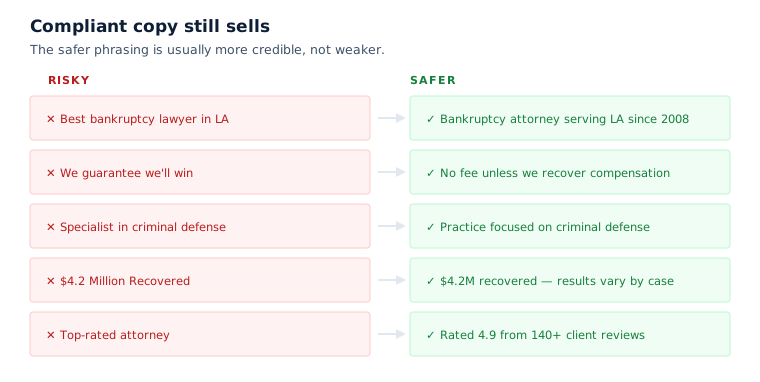
| Best bankruptcy lawyer in Los Angeles | Bankruptcy attorney serving Los Angeles since 2008 |
| We guarantee we'll win your case | No fee unless we recover compensation |
| Specialist in criminal defense | Practice focused on criminal defense |
| $4.2 Million Recovered | $4.2M recovered — results depend on the facts of each case |
| Top-rated attorney | Rated 4.9 on Google from 140+ client reviews |
| We've never lost a case | Over 500 cases handled since 2008 |
Presenting Case Results
Case results are persuasive and heavily regulated. The common requirements across jurisdictions are a disclaimer that prior results do not guarantee a similar outcome, a disclaimer that results depend on the specific facts of each case, sufficient context that the result is not misleading, and placement of the disclaimer where it is actually visible rather than buried in the footer.
Some states impose additional requirements, such as disclosing whether the figure is gross or net of fees and costs. Confirm your jurisdiction's specifics before publishing a results page.
"Prior results do not guarantee a similar outcome. Every case is different, and the results obtained in any particular matter depend on its specific facts and circumstances. The amounts shown reflect gross recovery before deduction of attorney's fees and costs."
Testimonials and Reviews
Client testimonials are restricted in most states and prohibited in a few. Where permitted, common conditions include a disclaimer that the testimonial does not constitute a guarantee, disclosure if the testimonial is not from an actual client, and disclosure if anything of value was provided.
Unsolicited third-party reviews on Google or Avvo sit in a different posture than testimonials you solicit and publish on your own site — but displaying selected reviews on your website can bring them back within the testimonial rules. Our review management guide covers the operational side, including the confidentiality constraints on responding.
Compliance is built into everything we write
Every ad, landing page, and website we produce is drafted with bar advertising rules in mind from the start — not reviewed for violations afterward.
Required Disclosures
Most jurisdictions require certain disclosures on law firm websites and advertising. The recurring ones are identification of the attorney or firm responsible for the content, the firm's office address, a statement that the material is attorney advertising, a disclaimer that the site does not create an attorney-client relationship, and a statement that the content is not legal advice.
Some states require additional items, such as disclosure of jurisdictions where attorneys are licensed when advertising reaches beyond those states. Templated law firm websites frequently ship without any of this.
Advertising Across State Lines
Digital advertising does not respect state boundaries. A website reaches every state, and Google Ads can be seen outside your targeting if configuration is loose.
The general principle is that a lawyer advertising into a jurisdiction may be subject to that jurisdiction's rules. Practically, firms advertising in multiple states should comply with the strictest applicable rule rather than the most permissive, disclose the states where attorneys are licensed, and avoid implying capability to practice where they are not admitted.
Beyond wasting budget, loose geographic targeting in Google Ads can place your advertising in jurisdictions where you are not admitted. Set location targeting to people in your target area, exclude states where you do not practice, and review the geographic report periodically.
Channel-Specific Notes
| Channel | Principal Risks |
|---|---|
| Google Ads | Superlatives and guarantees in headlines; character limits pressure toward overclaiming; geographic bleed |
| Google Business Profile | Description claims; responding to reviews without breaching confidentiality |
| Website | Missing required disclosures; case results without disclaimers; testimonial rules |
| Social media | Informal tone producing unintended advice; comment replies creating apparent relationships |
| Email & SMS outreach | Solicitation rules; TCPA consent requirements layered on top of bar rules |
| Landing pages | Aggressive conversion copy drifting into guarantees |
Auditing What You Have
A practical self-audit takes an afternoon. Read every page of your site looking specifically for superlatives, guarantees, and results without disclaimers. Export your Google Ads copy and read every headline and description in isolation. Read your Google Business Profile description. Check that required disclosures appear and are visible. Confirm case results carry proper disclaimers in a visible position.
Where you find problems, fix the language rather than removing the page — compliant copy performs nearly as well, and the version that survives a grievance is worth considerably more than the version that does not.
Documenting Compliance
If a grievance ever arrives, the difference between a brief exchange and a protracted problem is often whether you can show that compliance was considered rather than ignored.
Keep a record of what your advertising said and when. Archive ad copy when campaigns change, keep dated screenshots of key website pages, and retain the substantiation for any factual claim you publish — the source of a ranking, the methodology behind a statistic, the underlying records for a case result. If you rely on an agency, get in writing that compliance review is part of their process and identify who performs it.
This is inexpensive insurance. It takes minutes per campaign and turns a defensive scramble into producing a file.
Frequently Asked Questions
Generally no, unless the claim can be factually substantiated. Superlatives like 'best,' 'top,' and 'number one' require substantiation in most states, and some prohibit them regardless. Where a ranking comes from a legitimate third party with published methodology, use is often permitted with proper attribution. Safer alternatives describe verifiable facts, such as years in practice or an actual review rating.
In most states yes, because it describes a contingency fee arrangement rather than guaranteeing an outcome, though several jurisdictions require additional language clarifying the client's responsibility for costs. Phrasing that shifts toward guaranteeing a win, such as 'we win your case or you pay nothing,' reads as an outcome guarantee and carries materially more risk.
Commonly required items include identification of the attorney responsible for the content, the firm's office address, a statement that the material is attorney advertising, a disclaimer that the site does not create an attorney-client relationship, and a statement that content is general information rather than legal advice. Case results generally require their own disclaimers. Requirements vary by state, so confirm your jurisdiction's rules.
It depends on your state. Testimonials are restricted in most jurisdictions and prohibited in a few. Where permitted, conditions typically include a disclaimer that the testimonial does not guarantee a similar outcome, disclosure if the speaker is not an actual client, and disclosure if anything of value was provided. Displaying selected third-party reviews on your own website can bring them within testimonial rules.
Yes. Ad copy is attorney advertising and is subject to the same rules as your website. The character limits in search ads create pressure toward compressed, overclaiming language, which is where violations most often appear. Geographic targeting is also a compliance concern, because loose targeting can place your advertising in states where you are not admitted.
Consequences range from an informal complaint resolved by correcting the material, through mandatory remediation, to formal discipline in serious or repeated cases. Even a grievance that resolves in your favor consumes significant time and attention. The practical takeaway is that compliant copy performs nearly as well as non-compliant copy, so the risk is rarely worth taking.