Every law firm wants more leads. Very few can tell you what a lead costs them, what percentage convert, or which source produces clients who actually pay. That gap is where marketing budgets disappear.
This guide covers where legal leads come from, what each source genuinely costs, how to judge quality before you buy, and how to build an intake process that converts what you generate.
- Lead volume is meaningless without a definition of what qualifies. Define it in writing before you buy anything.
- Shared leads sold to four firms are a race. Exclusive leads cost more and convert far better.
- Speed to contact is the strongest single predictor of whether a legal lead converts.
- Pay-per-lead shifts risk to the vendor and suits firms with high intake capacity and tight margins.
- Track cost per signed case, not cost per lead. They are different numbers and only one pays the rent.
Where Legal Leads Come From
| Source | Control | Typical Cost | Quality |
|---|---|---|---|
| Your own Google Ads | Full | $50–$500 / click | High — you set the targeting |
| Your own organic & Map Pack | Full | Time & retainer | Highest |
| Local Services Ads | Partial | Per lead, Google-set | High |
| Exclusive pay-per-lead | Partial | $100–$350 / lead | Varies by vendor |
| Shared lead marketplaces | Minimal | $40–$150 / lead | Low — sold to several firms |
| Legal directories | Partial | Subscription | Moderate |
| Referrals | Full | Near zero | Highest close rate |
Owned versus purchased
Leads you generate yourself — through your website, your Google Business Profile, your ads — are the most valuable because you control targeting, you own the asset, and nobody else receives the same inquiry. The trade-off is that building owned channels takes time and ongoing investment.
Purchased leads produce volume immediately. The trade-off is control: you did not choose the keyword, you did not write the form, and in the case of shared leads you are one of several firms receiving the same person's contact information at the same moment.
Defining Lead Quality Before You Buy
The most common dispute between a law firm and a lead vendor is what counts as a lead. Resolve it in writing before any money changes hands.
A workable definition for a legal lead specifies the practice area — the person has a matter in the area you actually handle. It specifies geography — the person is within your jurisdiction and service area. It specifies contact validity — a real phone number that connects to a real person. It specifies engagement — the person affirmatively requested contact from an attorney. And it specifies exclusivity — whether the lead was sent to anyone else.
It should also specify what does not count and is not billable: wrong numbers, existing clients, solicitations, people outside your area, people whose matter falls outside your practice, and duplicates.
Any legitimate lead vendor has a process for crediting bad leads. Ask what the window is, what evidence is required, and what percentage of leads are typically credited. A vendor that resists this conversation is telling you something important.
Speed Is the Whole Game
Response time predicts legal lead conversion more strongly than any other operational variable. The person who submitted a form at 9:14 p.m. after a car accident is frightened and is contacting multiple firms. Whoever calls back first and sounds competent gets the case.
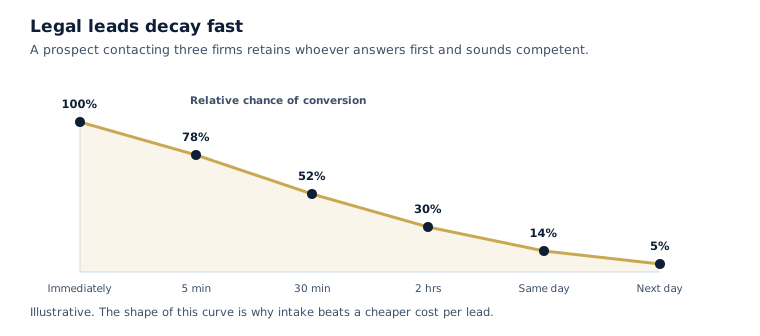
Practically, this means responding to web form submissions within minutes rather than hours, answering the phone every time during business hours, using an answering service that takes real information after hours for urgent practice areas, and following up more than once — most firms give up after a single attempt, and a meaningful share of leads convert on the third or fourth touch.
Want to see your rankings move before you pay?
Every Attorney Pro Marketing package starts with a free 14-day period: day-0 snapshot, new site and rebuilt profile live within three days, ranking report 14 days later. You decide on day 14.
How Pay-Per-Lead Works
In a pay-per-lead arrangement, the vendor absorbs advertising cost and risk, and the firm pays a flat rate only for delivered leads meeting the agreed definition. It appeals to firms that want predictable per-unit economics without managing ad accounts.
It fits firms with genuine intake capacity, since leads arrive on the vendor's schedule rather than yours, and a firm that cannot respond within minutes will convert poorly and blame the leads. It fits practice areas where case value comfortably exceeds lead cost. And it fits firms that have defined what a good case looks like, because volume without filtering just fills the calendar with matters you do not want.
It fits poorly for solo attorneys handling their own intake between hearings, and for firms whose average fee cannot absorb the per-lead price at a realistic close rate. Typical legal lead pricing runs $100–$200 for criminal defense, $150–$300 for family law, and $200–$350 for personal injury, with variation by market. Our packages publishes full pricing by practice area.
The Math That Decides Everything
Whether any lead source works for your firm comes down to one calculation, and most firms never run it.
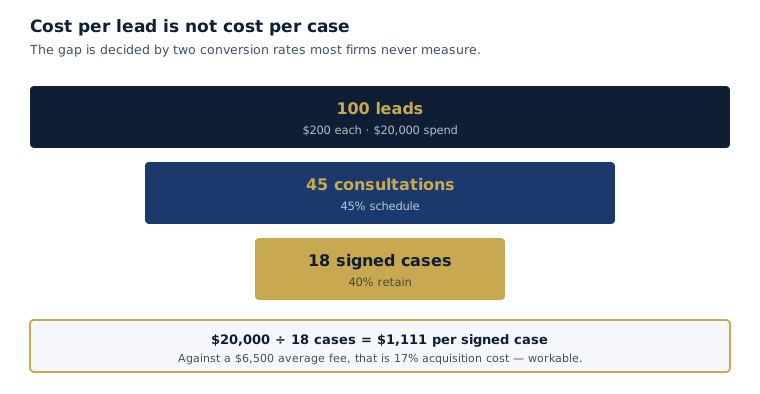
Start with the cost per lead. Apply your lead-to-consultation rate — how many leads actually schedule. Apply your consultation-to-retainer rate. That produces your cost per signed case. Compare it against your average fee.
| Bankruptcy Firm | Personal Injury Firm | |
|---|---|---|
| Cost per lead | $180 | $275 |
| Lead → consultation | 55% | 40% |
| Consultation → retainer | 45% | 35% |
| Cost per signed case | $727 | $1,964 |
| Average fee | $1,800 | $28,000 |
| Acquisition cost as % of fee | 40% | 7% |
| Verdict | Workable only with tight intake | Strongly profitable |
The same lead source can be excellent for one firm and unworkable for another. This is why blanket advice about lead generation is useless and why our budget guide starts from case economics rather than a spending percentage.
Intake Converts What Marketing Delivers
A firm with mediocre leads and excellent intake will outperform a firm with excellent leads and mediocre intake every time. Intake is the highest-leverage and most neglected part of the funnel.
The elements that matter: a consistent script that qualifies quickly without interrogating, a warm handoff to the attorney rather than "someone will call you back," same-day or next-day consultation availability, a documented follow-up sequence for people who do not schedule immediately, and a system of record so no inquiry falls through.
Recording and reviewing intake calls — with consent where required — usually reveals more improvement opportunity in a week than a month of campaign optimization.
Red Flags in Lead Vendors
Certain patterns reliably signal a vendor that will waste your money: refusal to define what counts as a billable lead, no credit or dispute policy, long-term contracts with minimum purchase commitments, vagueness about whether leads are exclusive or shared, no call recording or verification, inability to say where leads are generated, and pressure to commit to volume before a small test.
The counter-move is simple. Start with a small volume, define quality in writing, track every lead through to signed case, and expand only what proves out.
Nurturing the Leads That Don't Sign Today
A significant share of legal leads are not ready to retain on first contact. Someone researching divorce may be six weeks from filing. Someone considering bankruptcy may be waiting to see whether a tax refund resolves the problem. Firms that treat a non-conversion as a dead lead throw away cases they already paid for.
A functioning nurture process is unglamorous. Tag every lead that did not convert with a reason and a realistic timeframe. Follow up on a defined schedule rather than when someone remembers. Send genuinely useful material — a page explaining the process, an answer to the specific concern they raised — rather than a check-in that adds nothing. And keep the follow-up personal, from the attorney or the intake coordinator they spoke with, not from a generic marketing address.
The economics are compelling. A lead you already paid for costs nothing additional to contact again, so every case recovered from nurture directly reduces your blended cost per signed case.
Frequently Asked Questions
Pricing varies by practice area and market. Criminal defense and DUI leads typically run $100 to $200, family law $150 to $300, bankruptcy $150 to $250, immigration $150 to $275, estate planning $175 to $300, and personal injury $200 to $350. Shared leads sold to multiple firms cost less but convert far worse, so the meaningful comparison is cost per signed case rather than cost per lead.
An exclusive lead is delivered only to your firm. A shared lead is sold simultaneously to several firms, all of whom call the same person within minutes. Shared leads cost less per unit and convert at a fraction of the rate because the prospect is fielding multiple calls and retains whoever reaches them first and sounds most competent. Exclusive leads almost always produce a lower cost per signed case.
Within minutes for urgent practice areas. Response time is the single strongest operational predictor of legal lead conversion. Someone who submitted a form after a car accident or an arrest is contacting several firms, and whoever calls back first with a competent answer typically gets the case. Firms responding the next business day are effectively paying for leads that convert for someone else.
It depends on your intake capacity and case economics. Pay-per-lead shifts advertising risk to the vendor and gives predictable per-unit costs, which suits firms with staffed intake and case values that comfortably exceed lead prices. A retainer model with your own ad account gives you full control of targeting and builds an asset you own. Firms with tight margins and strong intake often favor pay-per-lead; firms building long-term visibility favor owned channels.
Usually because quality was never defined in writing before purchase, or because the firm's response time is too slow to convert leads that were actually fine. Before buying from any vendor, specify what counts as billable: correct practice area, correct geography, valid contact information, affirmative request for attorney contact, and exclusivity. Then track conversion by source so you can tell a vendor problem from an intake problem.
Take your cost per lead, multiply by the inverse of your lead-to-consultation rate, then multiply by the inverse of your consultation-to-retainer rate. For example, a $180 lead with 55 percent scheduling and 45 percent retaining produces roughly $727 per signed case. Compare that to your average fee to judge whether the channel is viable. Acquisition cost above about 25 to 30 percent of average fee is difficult to sustain in most practice areas.
It varies enormously by practice area, market and how the listing is used, and plenty of lawyers report paying for directory placement and signing nothing from it. Before buying, ask what you would need to sign to break even, then track inquiries from that source separately with its own tracking number so you can answer the question with your own data after 90 days rather than relying on anyone's impression. Directories tend to do better in practice areas where people comparison-shop and worse where inquiries are urgent.