Legal keywords are the most expensive words in advertising. A single click on "personal injury attorney" in a major metro can cost more than a family dinner. Firms routinely spend five figures a month and cannot say with confidence how many cases it produced.
That is not because paid search does not work for law firms. It is because most legal PPC accounts are structured in ways that guarantee waste. This guide covers how attorney PPC actually works, how to build campaigns that produce retainers instead of clicks, and how to read a report and know whether you are being managed or billed.
- Legal clicks cost $50–$500+. At those prices, match type discipline and negative keywords are the difference between profit and loss.
- Campaign structure should follow case type and intent stage, never a single campaign holding every keyword.
- Sending paid traffic to your homepage is the most common and most expensive mistake in legal PPC.
- Call tracking is mandatory. Most legal PPC conversions are phone calls, and untracked calls are unattributed revenue.
- Your ad copy is subject to bar advertising rules. Outcome guarantees and unsubstantiated superlatives create real exposure.
The Economics of Legal Clicks
Before touching an account, understand what you are buying. Legal is the most competitive advertising vertical in existence because a single conversion can be worth tens of thousands of dollars in fees. That value gets bid into the auction.
| Practice Area | Typical CPC Range | Typical Case Value | Viable CPA Ceiling |
|---|---|---|---|
| Personal Injury | $80–$500+ | $25,000–$100,000+ | Very high |
| Mass Tort / Class Action | $100–$800+ | Varies widely | Very high |
| Criminal Defense / DUI | $30–$150 | $5,000–$30,000 | High |
| Family Law / Divorce | $20–$90 | $5,000–$25,000 | Moderate |
| Immigration | $12–$60 | $3,000–$15,000 | Moderate |
| Bankruptcy | $15–$70 | $1,500–$10,000 | Tight |
| Estate Planning | $10–$45 | $1,500–$10,000 | Moderate |
The practical consequence: a bankruptcy firm and a personal injury firm cannot run the same playbook. At $50 a click and a one-in-fifteen click-to-retainer rate, a bankruptcy case costs $750 to acquire against a $2,000 fee. That is survivable only with disciplined targeting and fast intake. The same math on a personal injury case is trivially profitable.
Campaign Structure That Works
The single biggest structural failure in legal PPC accounts is the everything campaign — one campaign, one ad group, two hundred keywords, one landing page. It makes bid control impossible and guarantees that your best keywords subsidize your worst.
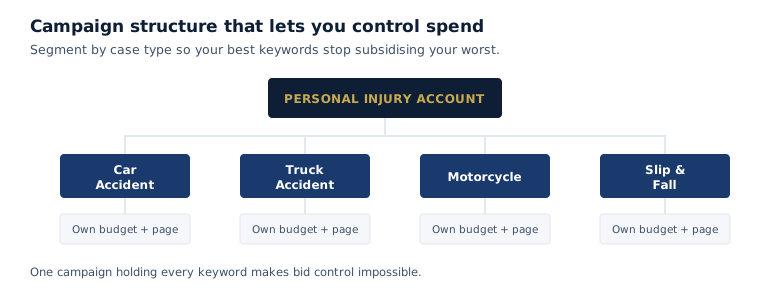
The correct structure segments by case type first and intent stage second. A personal injury account should have separate campaigns for car accidents, truck accidents, motorcycle accidents, slip and fall, and wrongful death, because the client, the message, and the case value differ in each.
Segment campaigns by case type
Each case type gets its own campaign with its own budget. This lets you shift money toward the case types that actually sign and away from the ones that generate calls but not retainers.
Separate high-intent from research-intent
"Car accident lawyer near me" and "what to do after a car accident" are different people. The first is hiring; the second is reading. Bidding the same on both wastes budget on traffic that will not convert this month.
Build geographic discipline
Target by radius around your actual service area, exclude locations you cannot serve, and set location targeting to people in your target area rather than people interested in it. This one setting eliminates a meaningful share of wasted spend.
Match one landing page per campaign
Every campaign points to a page that matches its search intent, with a headline echoing the query. Message match drives both conversion rate and Quality Score, which lowers your cost per click.
Keywords and the Negative List
At legal CPCs, your negative keyword list is as valuable as your keyword list. Every irrelevant click you prevent is money returned to the campaign.
Certain categories should be excluded in nearly every legal account from day one: job seekers searching "attorney jobs" or "paralegal salary," students searching "how to become a lawyer," people seeking free help via "free lawyer," "pro bono," or "legal aid," and DIY searchers using "template," "form," or "do it myself."
Beyond the universal list, practice-specific negatives matter enormously. A bankruptcy firm should exclude "bankruptcy court records," "chapter 11" if it only handles consumer cases, and the names of large national filing mills. A family law firm should exclude "divorce papers pdf" and "how to file divorce without a lawyer."
The search terms report shows the actual queries that triggered your ads, which is different from your keyword list. Reviewing it weekly and adding negatives is the highest-return maintenance task in any legal account. An account where nobody has reviewed search terms in ninety days is an account leaking money.
Match types in a high-CPC environment
Broad match in a legal account is expensive education. Google will show your ad for queries that are semantically adjacent but commercially useless, and you will pay premium legal rates for each of them. Start with phrase and exact match, build your keyword list from what the search terms report reveals, and introduce broad match only with a mature negative list and conversion data feeding automated bidding.
Already running ads and unsure if they work?
A free audit reviews your account structure, wasted spend, search terms, landing page match, and tracking setup — and tells you plainly what is broken.
Landing Pages Decide Whether Ads Work
You can run a flawless campaign into a bad landing page and lose money every single day. Paid traffic behaves differently from organic traffic: it arrives with a specific question, low patience, and a competitor one back-button away.
A legal landing page that converts does a small number of things extremely well. The headline restates the searcher's query, so the person immediately knows they are in the right place. The phone number is large, tappable, and above the fold on mobile. Trust signals — years in practice, bar admissions, case results with proper disclaimers, real reviews — appear before any scrolling is required. The form asks for the minimum: name, phone, and a short description. And the page loads in under two seconds.
What it does not have is site navigation. Navigation on a landing page is an invitation to leave. Our landing page service builds practice-area-specific pages that typically convert in the 8–12% range against an industry norm closer to 2–3%.
Tracking: Calls Are the Conversion
In most legal accounts, the majority of conversions are phone calls rather than form submissions. Any setup that only tracks form fills is blind to most of what the campaign produced.
A correct legal PPC tracking setup includes call tracking with dynamic number insertion, so the number displayed changes based on traffic source and each call is attributed to a campaign and keyword. It includes conversion actions configured for calls over a meaningful duration — a thirty-second call is a wrong number, a two-minute call is a prospect. It includes form submission tracking. And ideally it includes lead quality feedback from intake, so the account optimizes toward keywords that produce signed cases rather than keywords that produce ringing phones.
Recording calls is invaluable for grading lead quality, but consent requirements vary by state and several states require all-party consent. Confirm your obligations before enabling recording, and use the required announcement where applicable.
Ad Copy and Bar Rules
Ad copy is attorney advertising and is subject to your state bar's rules. Generic agencies write legal ads the way they write plumbing ads, and the result is copy that performs well in the auction and creates exposure for you.
The recurring problems: outcome guarantees such as "We Win or You Don't Pay" stated without qualification, superlatives like "Best Injury Lawyer in Dallas" that cannot be substantiated, specific case results in ad copy without the disclaimers most states require, and claims of specialization or certification the attorney does not hold.
Compliant copy still sells. "Free Consultation · No Fee Unless We Recover" communicates the same economics as a guarantee while staying inside the rules in most jurisdictions. Our compliance guide covers the detail by category.
Ongoing Optimization
Legal PPC is not a set-and-forget channel. Competitors change bids, Google changes auction dynamics, and search behavior shifts seasonally. An account nobody has touched in a month is an account drifting toward waste.
A competent weekly cadence covers the search terms report and negative additions, bid adjustments by device, time of day, and geography, ad copy testing with at least two variants per ad group, budget reallocation from underperforming to overperforming campaigns, and a landing page conversion review. Monthly work adds competitor analysis, Quality Score review, and a fresh look at which keywords produce signed cases versus merely calls.
| Signal | What It Suggests | Action |
|---|---|---|
| High clicks, low calls | Landing page or message mismatch | Rewrite page headline to match query intent |
| High calls, low retainers | Wrong keywords attracting wrong clients | Tighten keywords; add negatives; review intake script |
| Rising CPC, flat volume | New competitor or Quality Score decline | Audit ad relevance and landing page experience |
| Strong weekday, weak weekend | Intake coverage gap | Add after-hours answering or dayparting |
| Budget exhausted by noon | Budget too low for keyword set | Narrow keywords or raise budget; do not do both |
Where Local Services Ads Fit
Google Local Services Ads occupy the space above traditional Google Ads and operate on a pay-per-lead rather than pay-per-click model. They also require passing Google Screened, which includes a background check and bar verification.
For firms that qualify, LSAs frequently deliver a lower cost per lead than search ads and carry the credibility of the Google Screened badge. They do not replace search ads — inventory is limited and you cannot control keywords the same way — but they belong in the mix. Our Local Services Ads guide covers eligibility and setup.
Frequently Asked Questions
Cost per click ranges from roughly $10 for estate planning terms to $500 or more for competitive personal injury keywords in major metros. What matters more than CPC is cost per signed case. A $200 click is cheap if it converts to a $40,000 personal injury retainer and ruinous if it converts to a $1,500 bankruptcy case. Build your budget from case value and close rate rather than from a click price.
No. Sending paid traffic to a homepage is the most common and most expensive mistake in legal PPC. A homepage speaks to everyone and converts poorly. A dedicated landing page that matches the search query, removes navigation, and presents one clear action typically converts at three to four times the rate of a homepage.
Well-built practice-area landing pages generally convert in the 8 to 12 percent range for paid traffic. The broader industry average sits closer to 2 to 3 percent, which is largely a function of firms sending ads to generic pages. Conversion rate varies by practice area urgency, with crisis practices converting higher than planning practices.
Yes. The majority of conversions in legal PPC are phone calls, not form submissions. Without call tracking and dynamic number insertion, you cannot attribute calls to campaigns or keywords, which means you cannot optimize toward what actually produces cases. Any agency managing legal ads without call tracking is managing blind.
Calls typically begin within days of launch. Meaningful optimization requires 60 to 90 days of conversion data before the account stabilizes and automated bidding has enough signal to perform. Expect the first month to be expensive relative to results while negatives are built and search terms are cleaned up.
Technically yes, and some solo attorneys do. The difficulty is that legal CPCs punish mistakes severely. A poorly structured account can burn through a month's budget on job seekers and DIY searchers before anyone notices. If you run it yourself, commit to reviewing the search terms report weekly and building an aggressive negative keyword list from day one.