A law firm website has one job: turn a stranger with a legal problem into a phone call. Most firm websites are built to do something else entirely — to look impressive, to list credentials, to satisfy the partners' aesthetic preferences. Those sites lose cases to plainer sites that load faster and make it obvious how to get help.
This guide covers what actually drives conversion on a law firm website, what the technical requirements are in 2026, and how to tell whether your current site is helping or quietly costing you clients.
- Mobile-first is not a preference. Most urgent legal searches happen on a phone, often in distress.
- Under two seconds to load, or you lose a meaningful share of visitors before the page appears.
- Every practice area needs a substantive page of its own. A combined services page ranks for nothing.
- Trust signals above the fold beat design polish for conversion.
- Confirm who owns the site, the domain, and the content before you sign anything.
What the Site Is Actually For
Before design, settle the purpose. A law firm website serves three functions in priority order: convert visitors into calls and form submissions, rank in search so visitors arrive at all, and establish enough credibility that a stranger trusts you with a serious problem.
Everything else — animation, custom photography, elaborate navigation — is subordinate. When a design decision improves aesthetics and harms any of the three, it is the wrong decision.
Mobile First, Genuinely
Over seventy percent of urgent legal searches happen on mobile, and the figure runs higher for criminal defense and personal injury where the search often happens within hours of the triggering event.
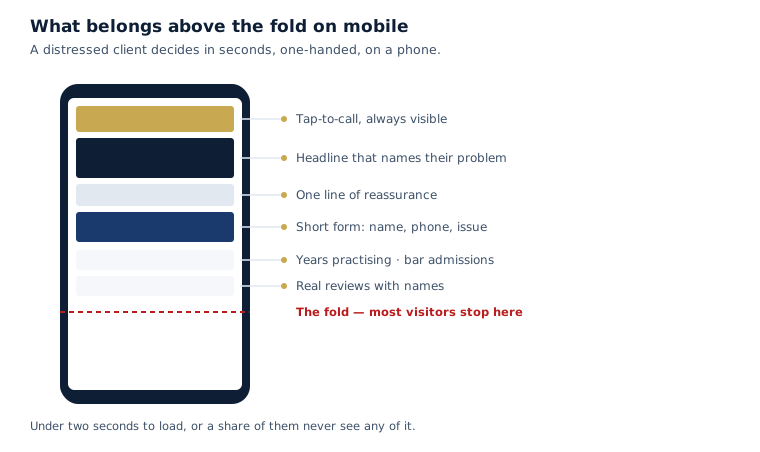
Mobile-first means designing the phone experience first and adapting upward, not building a desktop site and letting it shrink. In practice that means the phone number is tappable and visible without scrolling, tap targets are large enough for imprecise thumbs, text is legible without zooming, forms are short enough to complete one-handed, and nothing requires hovering.
Speed Is a Ranking and Conversion Factor
Google measures page experience through Core Web Vitals, and slow sites rank worse. Independently, slow sites convert worse, because a person in distress does not wait.
Most law firm sites are slow for predictable reasons: bloated page builders that ship enormous stylesheets, unoptimized hero images, a dozen third-party scripts for chat widgets and analytics, and hosting chosen on price. The fix is usually structural rather than incremental — a lean build outperforms an optimized heavy build.
| Issue | Typical Cause | Fix |
|---|---|---|
| Slow first paint | Render-blocking CSS/JS | Inline critical CSS, defer the rest |
| Large images | Unoptimized hero photography | Modern formats, correct dimensions, lazy load |
| Layout shift | Images and embeds without dimensions | Set explicit width and height |
| Slow server response | Cheap shared hosting | Better host or static delivery |
| Script bloat | Chat, heatmaps, multiple tags | Audit and remove; load async |
Site Structure That Ranks
The single most consequential structural decision is giving every practice area its own substantive page. A firm handling bankruptcy, family law, and personal injury needs three deep pages, not one page listing three services.
Each practice area page should explain the legal process step by step, set expectations on timeline, explain how fees work, address the questions clients ask in consultations, and link to related content. That is typically 1,500 words or more, and it is the page that ranks and converts for that practice area.
Beyond practice areas, a complete structure includes an attorney bio page for each lawyer with credentials and bar admissions, a results or case studies page with appropriate disclaimers, a genuine About page, a contact page with a map and clear hours, and a content section for question-driven articles.
Bio pages are consistently among the highest-traffic pages on law firm sites, because prospective clients want to know who they will actually be working with. A thin bio that lists a law school and a year is a missed opportunity. Include background, why you practice in this area, bar admissions, and something human.
Want a straight answer on your current site?
We audit speed, mobile experience, structure, conversion paths, and search visibility — and tell you whether it needs a rebuild or a repair.
Conversion Elements That Matter
Conversion on a legal site comes down to reducing the friction and anxiety between arriving and reaching out.
The phone number belongs in the header on every page, tappable on mobile, and repeated at natural decision points. Forms should be short — name, phone, email, and a brief description of the situation. Every additional field measurably reduces completion. Trust signals belong above the fold: years in practice, number of cases handled, bar admissions, real reviews with names.
Calls to action should be specific rather than generic. "Talk to Alon about your case" outperforms "Submit." And the language throughout should acknowledge the visitor's actual situation rather than describing the firm. "Facing foreclosure? Here is what happens next" converts better than "Welcome to our firm."
Technical Requirements
A competent law firm site in 2026 has HTTPS across every page, a unique title tag and meta description per page, one H1 per page matching the page's purpose, structured data including LegalService and Organization markup, an XML sitemap and sensible robots.txt, clean descriptive URLs, and accessibility basics like alt text, keyboard navigation, and adequate contrast.
Accessibility deserves specific attention in the legal vertical. Law firms have been targeted in ADA website accessibility litigation, and a site that fails basic standards is both an exposure and a conversion problem for clients using assistive technology.
Required Disclaimers
Bar rules impose specific website requirements that vary by state but commonly include identifying the attorney responsible for the site's content, a disclaimer that the site is attorney advertising, a statement that viewing the site does not create an attorney-client relationship, disclaimers accompanying any case results, and required language around testimonials.
Our compliance guide covers these in detail. The short version is that a site missing them is exposed, and most templated law firm sites ship without them.
Who Owns the Website
This is the question most firms never ask and later regret. Many agencies build on proprietary platforms, register the domain in their own name, and retain the site if the relationship ends. Firms discover this when they try to leave and find they are starting over.
Ask before signing: who owns the domain registration, who owns the site files and content, what happens to the site at termination, and whether there is a buyout provision. There is no single correct arrangement — agencies that retain ownership during an engagement with a defined buyout are a legitimate model — but you need to know which model you are in on day one.
At minimum, insist the domain is registered in the firm's name with the firm as registrant, even if the agency manages DNS. Losing a domain you have built rankings on is the most costly version of this problem.
Rebuild or Repair
Rebuild when the site is slow at a structural level, is not genuinely mobile-first, lacks individual practice area pages, runs on an abandoned platform, or cannot be edited without a developer for routine changes.
Repair when the foundation is sound and the gaps are content depth, missing schema, weak conversion elements, or absent practice area pages. A functional site with thin content is a content project, not a design project, and rebuilding it wastes whatever search equity it has accumulated.
Forms, Chat, and Intake Tools
The tools bolted onto law firm websites to capture leads frequently do more harm than good, because each one adds load time and visual noise while competing with the phone number for attention.
Forms should be short. Name, phone, email, and a brief description of the situation is enough to start a conversation, and every additional required field measurably reduces completion. Asking for a case value estimate or a preferred appointment time before you have earned any trust suppresses submissions.
Live chat works when a real person answers within seconds during business hours. It works against you when it is an automated widget that greets the visitor with a scripted question and then fails to deliver a human. If you cannot staff it, do not run it — a chat window that goes unanswered is worse than no chat at all.
Online scheduling is genuinely useful for practice areas where consultations are routine, such as estate planning, and less useful for crisis practices where the client needs to talk to someone immediately rather than book a slot three days out.
Frequently Asked Questions
Templated sites from legal-specific vendors typically run $1,000 to $3,000 with monthly hosting. Custom builds range from $3,000 to $25,000 or more depending on page count and complexity. The more useful question is what the site produces: a $2,000 site that loads fast and converts at 8 percent outperforms a $20,000 site that loads in six seconds and buries the phone number.
Speed under two seconds, a tappable phone number visible without scrolling, trust signals above the fold, short forms, and substantive individual pages for each practice area. Language matters as much as layout: pages that acknowledge the visitor's actual situation convert better than pages describing the firm's credentials.
Yes. A combined services page listing bankruptcy, family law, and personal injury will not rank for any of them and converts poorly because it speaks to nobody specifically. Each practice area needs its own page covering the legal process, timeline, fee structure, and the questions clients ask in a consultation, typically 1,500 words or more.
WordPress is fine and widely used, but the platform matters less than how it is built. Most slow law firm sites are WordPress installs running heavy page builders and a dozen plugins. A lean WordPress build performs well; a bloated one does not. Static or lightly built sites often outperform on speed with less maintenance overhead.
It depends entirely on the agreement, and many firms never ask. Some agencies transfer everything, some retain ownership during the engagement with a buyout option, and some build on proprietary platforms you cannot take with you. Ask before signing who owns the domain, the files, and the content, and what happens at termination. At minimum insist the domain is registered in the firm's name.
Requirements vary by state bar but commonly include identifying the attorney responsible for the content, a statement that the site constitutes attorney advertising, a disclaimer that using the site does not create an attorney-client relationship, disclaimers accompanying any case results, and specific language around testimonials. Check your state's rules, as several jurisdictions impose additional requirements.