Most law firm marketing fails for a reason that has nothing to do with marketing. It fails because the firm never defined what a good case looks like, never built an intake process capable of converting one, and then bought traffic hoping volume would solve both problems.
This guide is a complete framework for law firm marketing — how the channels work, how they fit together, what each one costs, and how to sequence them based on where your firm actually is today.
- Intake capacity determines marketing strategy. Generating leads you cannot answer within minutes wastes the entire budget.
- Channel selection should follow practice area urgency. Crisis practices need paid search; planning practices need authority content.
- Referrals are a marketing channel and should be systematized, not left to chance.
- The correct budget is derived from case value and close rate, not from a percentage of revenue pulled from an industry article.
- Marketing that is not measured against signed cases is indistinguishable from spending money.
Start With Intake, Not Advertising
The most expensive mistake in legal marketing is buying leads a firm cannot process. Response time is the single largest determinant of whether a legal lead converts, and the decay curve is brutal. A prospect who calls three firms will retain whoever picks up and sounds competent. Calling back four hours later means calling someone who already signed with a competitor.
Before spending a dollar on advertising, three things need to be true. Someone answers the phone during business hours, every time, and a real answering service handles after-hours calls in urgent practice areas. Web form submissions get a response within fifteen minutes, not the next business day. Someone in the firm knows how to conduct a consultation that ends with a signed fee agreement rather than "think it over and call me back."
The Channels, Honestly Assessed
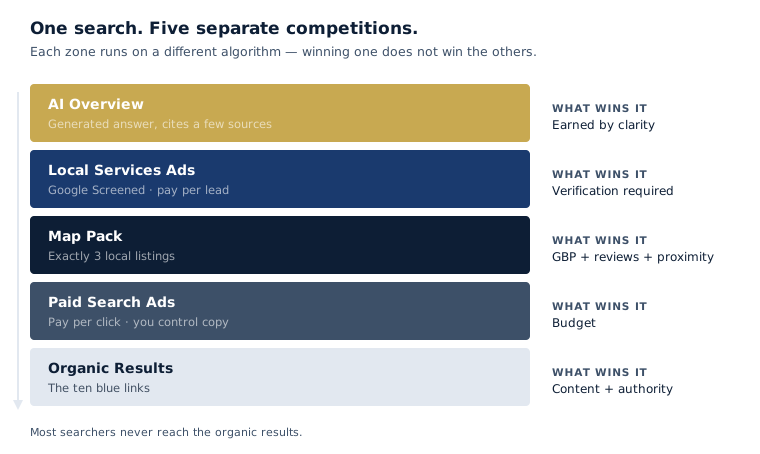
Every channel has a cost profile, a speed profile, and a practice-area fit. Here is how they compare.
| Channel | Time to Results | Cost Profile | Best Fit |
|---|---|---|---|
| Google Ads | Days | High, ongoing | Urgent practices with strong intake |
| Local Services Ads | Days–weeks | Per qualified lead | Firms that pass Google Screened |
| Google Business Profile | 2–6 weeks | Low, compounding | Nearly every local firm |
| Organic SEO / content | 3–12 months | Moderate, compounding | Firms with runway |
| Pay-per-lead | Immediate | Per lead, no retainer | High-capacity intake teams |
| Referral systems | Ongoing | Very low | Every firm, always |
| Social media | Months | Moderate | Brand-led & niche practices |
| Traditional (TV, billboard) | Months | Very high | Established firms with scale |
Paid search
Google Ads puts your firm in front of someone actively looking for an attorney right now. It is the fastest path from spend to signed case, and it is expensive — legal keywords are among the costliest in all of advertising, with some personal injury terms exceeding several hundred dollars per click in major markets.
Paid search works when three conditions hold: your case value can absorb the cost per acquisition, your intake converts quickly, and your campaigns are built around genuine commercial intent rather than broad-matched informational queries. Our PPC guide for lawyers covers the campaign architecture in detail.
Local search and the Map Pack
For the majority of firms, local search offers the best return per dollar available in legal marketing. The Map Pack sits above organic results and, on mobile, above nearly everything else. Getting there requires a complete and active Google Business Profile, consistent citations, and a functioning review program — not a large budget.
Referrals as a system
Most attorneys treat referrals as something that happens to them. Firms that systematize referrals treat them as a channel with owners, cadences, and tracking. That means a defined list of referral sources — other attorneys in adjacent practice areas, CPAs, financial advisors, past clients — and a deliberate rhythm of contact with each.
The reason this matters: referral cases close at dramatically higher rates than cold leads and cost virtually nothing to acquire. A firm generating twenty percent of new matters from a referral system has a structural cost advantage over a competitor buying every case.
Not sure which channel fits your firm?
A free audit reviews your current presence, your competitors, and your practice area economics, then recommends a sequence — not a package.
Marketing by Practice Area
Client psychology differs enormously across practice areas, and that difference should drive channel selection, messaging, and budget allocation.
| Practice Area | Client State | Primary Channel | Message That Works |
|---|---|---|---|
| Personal Injury | Injured, urgent | Paid search + Map Pack | Immediate help, no upfront fee |
| Criminal / DUI | Frightened, immediate | Paid search, 24/7 intake | Available now, discreet, experienced |
| Family Law | Emotional, deliberate | Local SEO + content | Calm guidance, clarity on process |
| Bankruptcy | Ashamed, urgent | Local SEO + content | Judgment-free, plain-English relief |
| Immigration | Anxious, community-driven | Map Pack + reviews | Trustworthy, multilingual, proven |
| Estate Planning | Planful, unhurried | Content + referrals | Authority, thoroughness, family protection |
A campaign that works for a DUI practice will fail for an estate planning practice, because one client is in crisis at 2 a.m. and the other is researching on a Sunday afternoon with no deadline. Messaging that creates urgency converts the first and repels the second.
Setting a Budget That Makes Sense
The standard advice — spend between two and ten percent of revenue on marketing — is close to useless because it ignores case value, close rate, and market cost.
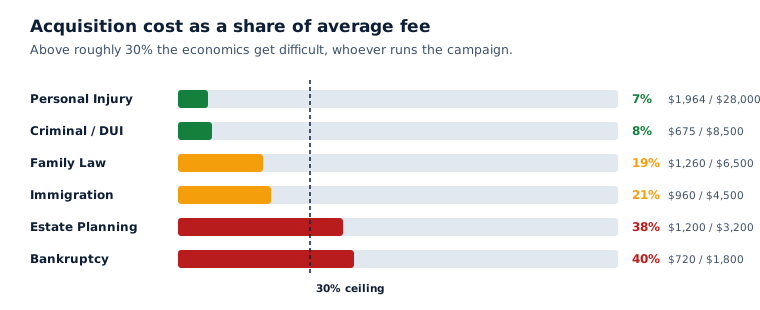
Build the number from the bottom instead. Start with your average fee per signed case. Apply your consultation-to-retainer close rate. That tells you the maximum you can pay per qualified lead while remaining profitable. Then look at what qualified leads actually cost in your market and practice area. If the two numbers are compatible, the channel is viable. If they are not, that channel will not work for your firm no matter how well it is managed.
A bankruptcy firm averaging $1,800 per case that converts one in three consultations can afford roughly $180 per qualified lead at a 10% cost-of-acquisition target. If bankruptcy leads in that market run $150–$250, the channel is marginal and intake efficiency becomes the deciding variable. A personal injury firm averaging $28,000 per case at the same close rate can absorb an order of magnitude more.
Our law firm marketing budget guide works through this math in detail, including how to model against practice-area benchmarks.
Your Website Is Infrastructure
Every channel above ultimately routes to your website. A firm with excellent ads and a website that loads in six seconds and offers no clear way to call is lighting money on fire at the last step.
The requirements are unglamorous and non-negotiable. Load in under two seconds on mobile. Make the phone number tappable and visible without scrolling. Keep contact forms short — name, phone, brief description. Present trust signals prominently: years practicing, bar admissions, real reviews. Give every practice area its own substantive page rather than a single combined services page.
Details on all of this are in our law firm website design guide.
Measurement and Attribution
You cannot manage what you do not measure, and in legal marketing the measurement problem is real: clients frequently touch several channels before calling, and phone calls are harder to attribute than form fills.
Call tracking solves most of it. A distinct tracking number per channel, with dynamic number insertion on the website, tells you which source produced each call. Recording calls — with appropriate consent under your state's law — lets you grade lead quality rather than just counting volume, which matters because a hundred unqualified calls is worse than ten good ones.
Beyond call tracking, the discipline that separates firms that grow from firms that guess is simple: record the source of every new matter at intake, and review it monthly against spend. That single practice reveals more than any analytics dashboard.
The Five Most Expensive Mistakes
Advertising before intake is ready
Every unanswered call is a case that went to a competitor, paid for with your money.
Hiring a generalist agency
Legal advertising has compliance rules, unique client psychology, and keyword economics unlike any other vertical. Agencies that also handle restaurants learn on your budget.
Signing a long-term contract
Twelve-month agreements exist to protect the agency from the consequences of poor results. Month-to-month terms align incentives correctly.
Not owning your assets
Find out before you sign who owns the website, the domain, and the ad account. Many firms discover the answer only when they try to leave.
Optimizing for traffic instead of cases
A report showing rising sessions while signed cases stay flat is a report describing failure in flattering language.
Frequently Asked Questions
Derive the number from case economics rather than a revenue percentage. Take your average fee per signed case, apply your consultation-to-retainer close rate, and that yields the maximum you can profitably pay per qualified lead. Compare that to actual lead costs in your market and practice area. A bankruptcy firm averaging $1,800 per case and a personal injury firm averaging $28,000 per case should have wildly different budgets, and no percentage-of-revenue rule captures that.
It depends on practice area urgency and your intake capacity. Crisis practices like criminal defense and personal injury get the fastest return from Google Ads combined with Map Pack visibility, because clients search and hire within hours. Planning practices like estate planning perform better with authority content and referral systems, because clients research for weeks. Nearly every local firm benefits from Google Business Profile optimization regardless of practice area.
Paid search produces qualified calls within days of launch. Google Business Profile optimization shows measurable change in two to six weeks. Content and organic SEO take three to twelve months depending on competition. Referral systems build over quarters. Most firms should expect a blended program to show clear signal by month three and meaningful return by month six.
It depends on what you can execute internally. Claiming your Google Business Profile, requesting reviews, and writing genuinely useful client-facing content are all achievable without an agency. Campaign management, competitive content strategy, technical SEO, and conversion optimization generally require tools and time that practicing attorneys do not have. A reasonable approach for a small firm is handling local basics in-house and outsourcing the work that requires specialist tooling.
The most common cause is generating leads the firm cannot answer fast enough. Legal leads decay within minutes, and a prospect who reaches voicemail calls the next firm. The second most common cause is measuring traffic instead of signed cases, which allows an underperforming program to look successful in reporting while producing no revenue.
It remains the highest-margin channel available, and most firms underinvest in it because they treat referrals as passive. Firms that systematize referrals maintain a defined list of sources across adjacent practice areas and allied professionals, contact them on a deliberate cadence, and track which relationships produce matters. Referral cases close at far higher rates than cold leads and cost almost nothing to acquire.