Solo attorneys get marketing advice written for firms with staff and budgets. It is not that the advice is wrong, it is that it assumes resources you do not have.
This is a sequence built for one person with limited hours and limited money, ordered so that the cheapest high-impact work happens first.
Before You Spend Anything
Two things have to be true or everything downstream wastes money.
Someone answers the phone. If you are in a hearing and calls go to voicemail, you are paying to generate cases for the attorney the caller dials next. An answering service that takes real information costs a fraction of what a lost case costs.
You know what a good case looks like. Practice area, geography, and the kind of matter you actually want. Without that definition you will generate volume rather than clients.
Month One: Claim What Is Free
The entire first month is work that costs nothing but time and produces the largest proportional return available to a solo practice.
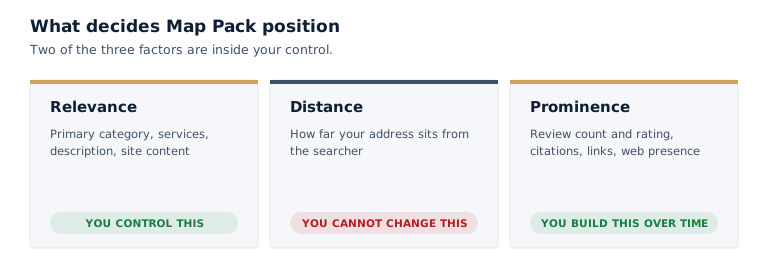
Claim and complete your Google Business Profile
Verify it, choose the most specific legal category that matches the cases you want, fill in every field, list your services individually, add hours and attributes, and upload photos. This is the single highest-return hour you will spend all quarter.
Fix your name, address, and phone everywhere
State bar directory, county bar, Avvo, Justia, Yelp, and anywhere else you appear. Make them identical. Inconsistency here quietly suppresses local ranking.
Start asking for reviews
Every client whose matter closes well, asked personally, the day it closes, with the direct link sent by text. Four a month from here forward.
Tell people you exist
Contact every attorney you know in adjacent practice areas and tell them specifically what you take. Referrals are the cheapest cases you will ever get and most solos never ask.
Month Two: Fix the Website and Write Three Pages
With the free work done, month two addresses the place everything eventually points.
If you have no website, you need one — but a fast, simple five-page site beats an elaborate one, and you do not need to spend five figures. If you have a site, the priority is speed and mobile experience before aesthetics. Check it on your phone: does it load in under two seconds, is the phone number tappable without scrolling, is it obvious what you do?
Then write three pages. One substantive page per practice area you want cases in, covering the actual process, timeline, how fees work, and the questions clients ask you in consultations. Not four hundred words of service description — the real explanation you give across the desk. Our content guide covers the structure.
Keep asking for reviews throughout. That does not stop.
Month Three: Add Paid, Carefully
Only now, with a functioning profile, consistent citations, accumulating reviews, and real practice area pages, does paid advertising make sense. Running ads before this point sends expensive traffic into a weak foundation.
Start small and narrow. One campaign, your highest-value practice area, tight geography, exact and phrase match only, a real negative keyword list from day one, and a dedicated landing page rather than your homepage. Set a budget you can sustain for ninety days, because a thirty-day test tells you nothing.
If your budget is genuinely small, consider Local Services Ads instead, since you pay per lead rather than per click and can dispute leads that do not qualify. Verification takes weeks, so start it early.
Start with the free week
We will optimize your Google Business Profile for a week at no cost and show you the before-and-after position across your service area. No card, no contract.
What to Ignore for Now
Solo attorneys get pitched constantly, and most of it is a poor use of limited resources in the first ninety days.
Social media consumes real time and rarely produces retained cases for a local practice in the short term. Blogging on a schedule produces filler unless each post answers a real client question. Shared lead marketplaces sell the same person to four firms. Expensive directory upgrades rarely justify their cost. And a website rebuild costing five figures is almost never the right first move for a solo practice.
What Comes After 90 Days
At the end of the quarter you should have a complete and active Google Business Profile, consistent citations, roughly a dozen new reviews, three substantive practice area pages, a referral conversation started with every attorney you know, and either a small paid campaign running or LSA verification in progress.
That is a real foundation, and it was built with a modest budget. From there the work is continuation rather than reinvention: keep asking for reviews, add a page a month answering a question clients actually ask, and scale the paid channel only once your intake can absorb the volume.
Common Questions
In the first ninety days, very little. The highest-return work — claiming and completing your Google Business Profile, fixing citation consistency, and building review volume — costs time rather than money. Paid advertising should come after that foundation exists, starting with a budget you can sustain for a full ninety days rather than a larger amount you will cancel in thirty.
Claim and fully complete your Google Business Profile, choosing the most specific legal category that matches the cases you want. It costs nothing, takes about an hour, and produces more return per hour than anything else available to a solo practice. Then make sure someone answers the phone.
Yes, but not an expensive one. A fast five-page site with a substantive page per practice area outperforms an elaborate site that loads slowly and buries the phone number. Prioritize mobile speed and clarity over design ambition, and connect it to your Google Business Profile.
Not before doing the free work yourself. Claiming your profile, fixing citations, and asking clients for reviews are all achievable solo and represent the largest available gains. An agency becomes worthwhile once you need campaign management, content at volume, or competitive strategy that requires tools and time you do not have.
Google Business Profile work shows measurable change in profile views and calls within two to six weeks. Reviews compound over months. Paid advertising produces calls within days of launch but needs sixty days of data to optimize. A realistic expectation is meaningful signal by month three and a functioning pipeline by month six.