Most attorneys evaluating a marketing agency ask about price and results. Both matter, and neither reveals much — every agency quotes a number and every agency has a case study.
These fifteen questions reveal the things that actually determine whether the relationship works, and most of them can be answered in a single call.
Ownership and Control
1. Who owns the domain name? The registrant should be your firm, even if the agency manages DNS. Losing a domain you have built rankings on is the most expensive version of this problem.
2. Who owns the website files and content? Some agencies transfer everything, some retain ownership during the engagement with a defined buyout, and some build on proprietary platforms you cannot take anywhere. Any of these can be a legitimate model. Not knowing which one you are in is not.
3. Whose name is on the Google Ads account? If the agency owns it, you lose the entire conversion history when you leave, which sets a new agency back months. Ask for the account to be created under your own billing with the agency granted access.
4. What happens to everything if we part ways? Ask them to walk through it concretely. A vague answer here is the single strongest predictor of a difficult exit.
Who Does the Work
5. Who writes the content? If content is produced by writers with no legal background, expect pages that are grammatically fine and substantively empty. Ask whether anyone on the team has legal experience.
6. Is any of this outsourced? Outsourcing is not automatically a problem, but you should know whether the people writing your practice area pages are in the building or in a marketplace.
7. Who will I actually talk to after I sign? A pattern worth watching for is a senior person on the sales call and an account coordinator thereafter. Ask directly who handles your account day to day.
8. How many law firms do you work with in my market? If they represent your direct competitor for the same keywords in the same city, one of you is being underserved by definition.
Reporting and Measurement
9. Can I see a live reporting dashboard from a current client? With identifying details removed. Vague answers here usually mean the reporting is a monthly PDF of traffic charts.
10. Do you track calls, and how? Most legal conversions are phone calls. An agency managing legal marketing without call tracking cannot tell you what produced a case, only what produced a visit.
11. What do you consider a conversion? If the answer is a form fill or a page view, you will get reports showing success while your case count stays flat. The answer you want involves qualified calls and, ideally, signed cases.
12. What happens if the numbers do not improve in ninety days? Listen for whether they have a diagnostic process or whether the answer is that SEO takes time.
Contract Terms
13. What is the contract term, and what is the cancellation process? Twelve-month agreements with early termination fees exist to protect the agency from the consequences of poor results. Month-to-month terms align incentives correctly. Ask for the cancellation clause specifically and read it.
14. What is included and what costs extra? Get the boundaries in writing. Common surprises include content beyond a page limit, landing pages, call tracking subscriptions, ad spend management above a threshold, and website changes classified as new development.
Compliance
15. How do you handle bar advertising rules? This question does more work than any other. An agency with legal experience will immediately discuss outcome guarantees, superlatives, case result disclaimers, and testimonial restrictions. A generalist agency will say something reassuring and general.
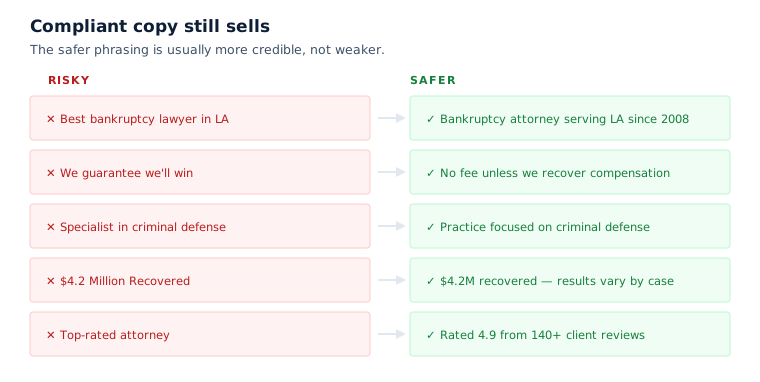
You are the one who receives the grievance, not the agency. Our compliance guide covers what they should know.
What Good Answers Sound Like
| Question | Weak Answer | Strong Answer |
|---|---|---|
| Who owns the site? | "You do, basically" | A specific clause they can point to |
| Who writes content? | "Our content team" | Named people, with legal background described |
| What is a conversion? | "Leads and traffic" | Qualified calls over a duration threshold |
| Contract term? | "Twelve months, standard" | Month-to-month with notice period |
| Bar compliance? | "We're careful about that" | Specific rules and how they handle each |
Ask us all fifteen
Attorney Pro Marketing is month-to-month, discloses ownership terms before you sign, and is run by a former practicing attorney. Put us through the list.
Common Questions
Focus on ownership of the domain, website, and ad account; who actually produces the work; how conversions are defined and tracked; the contract term and cancellation process; and how the agency handles bar advertising compliance. Price and case studies reveal far less, because every agency has both.
Month-to-month terms align incentives better, because the agency has to earn renewal every month. Long-term agreements are not automatically disqualifying, but you should understand why one is being required and read the cancellation clause carefully, including any early termination fees.
Your firm, with the agency granted access. If the agency owns the account, you lose the entire conversion history and campaign structure when the relationship ends, which sets any new agency back months and costs real money to rebuild.
Ask how they handle bar advertising rules. An agency with legal experience will immediately discuss outcome guarantees, unsubstantiated superlatives, case result disclaimers, and testimonial restrictions without prompting. A generalist will give a reassuring but non-specific answer, which tells you they have not encountered the rules.
Ask what would count as failure, and by what date. An agency that works from measurement can answer that; one that works from pitching cannot. Then ask for three specifics: a documented ranking baseline before anything starts, call tracking from day one so inquiries are attributable rather than guessed at, and reporting in inquiries and signed cases rather than impressions and rankings. Confident claims about signed cases are easy to make and hard to make falsifiable, which is why the falsifiability is the test.
Ask how they expect your firm to be found when a prospective client asks an AI assistant rather than typing a search, and what specifically they would change on your site to make that likelier. Useful answers involve structured data, clear factual pages that answer real questions, and consistent business information across the web. Treat guarantees of placement in AI answers as a red flag: no one can buy or promise a position in an AI assistant's response.