The call usually goes the same way. A firm that comfortably held a Map Pack slot for two years is suddenly at position nine, the phone is noticeably quieter, and nothing about the practice changed. Nobody touched the website. Nobody edited the profile.
In practice, almost every one of these cases traces to one of six causes. Here is how to identify which.
A Competitor Finally Did the Work
The most common explanation is the least satisfying: somebody else started trying. The Map Pack has exactly three slots, so a competitor entering the top three necessarily displaces someone.
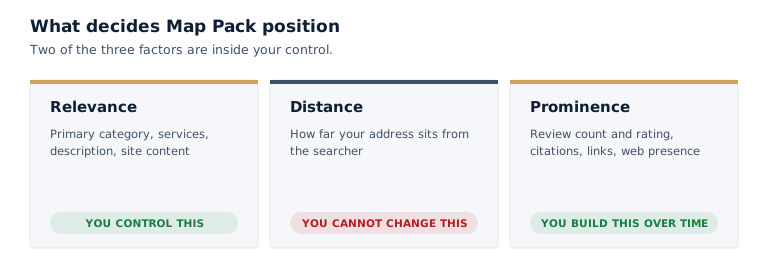
Check the firms now occupying the positions you held. Look at their review count and, more tellingly, the dates on their recent reviews. A firm that added sixty reviews in four months after sitting at fifteen for years has hired someone or built an internal process. Look at whether they are posting to their profile, whether their photos are recent, and whether their website got rebuilt.
If a competitor made a sustained push, the fix is not a trick. It is doing the work at a level that exceeds theirs, which is covered in our local SEO guide.
Your Review Flow Stopped
Review recency is a ranking input, and review programs decay quietly. The paralegal who used to ask every client leaves, nobody inherits the task, and six months later the firm has not received a review since spring while two competitors are adding four a month.
Look at your own profile and note the date of your most recent review. If it is more than six weeks old, you have found at least part of the problem.
Someone Changed a Category
Your primary category is the single highest-impact field on the profile, and it can change without you doing anything. Google occasionally reorganizes its category taxonomy and remaps businesses. Google also accepts suggested edits from the public, and while significant changes now trigger owner notification, edits still slip through on unmonitored profiles.
Open your profile and verify the primary category is still the specific one you chose — "Bankruptcy Attorney" rather than "Lawyer." A generic category dilutes relevance across every legal search in your market.
Citation Drift
Your name, address, and phone number are supposed to match everywhere they appear. Over years they drift. An old directory listing keeps a phone number you stopped using. A suite number gets dropped somewhere. A profile from a prior firm name never got updated.
Each inconsistency is minor. Accumulated across dozens of directories, they weaken the confidence Google has in your business data, which shows up as reduced prominence.
Soft Suspension and Policy Flags
Profiles can be restricted without an obvious notification. Common triggers in the legal vertical include a virtual office or coworking address that Google identifies as non-qualifying, keyword stuffing in the business name field — adding "Best Personal Injury Lawyer" after your firm name is a policy violation — a service area configured beyond what Google considers reasonable, or a bulk review removal following an audit.
Check your profile's status in the Business Profile dashboard. A profile showing as suspended or pending will not appear in the Map Pack at all, and firms sometimes go weeks without noticing.
Algorithm Updates
Google adjusts local ranking regularly, and some updates shift weighting enough to reshuffle competitive markets. These are real, but they are also the explanation agencies reach for when they have not diagnosed the actual cause.
The test is whether the drop is isolated to your firm or widespread. If several firms in your market moved simultaneously and the Map Pack composition changed broadly, an update is plausible. If only you dropped while everyone else held position, something specific to your profile changed.
The Diagnostic Sequence
Work through it in this order, because it moves from cheapest to most involved.
Check profile status
Confirm the profile is not suspended, restricted, or pending verification. This takes thirty seconds and explains the most severe drops.
Verify primary category
Confirm it is still the specific legal category you selected, not a generic one.
Date your last review
Anything older than six weeks means the review program needs restarting.
Run a grid scan
A single search from your office tells you nothing. Map your position across the whole service area to see whether you dropped everywhere or only in specific directions.
Audit the firms that replaced you
Their review velocity and profile activity will usually tell you exactly what changed.
We will run the diagnostic for you
A free Map Pack audit including a grid scan of your service area and a competitor comparison — reviewed personally, not generated by software.
Recovery timelines depend on cause. A suspension resolved through reinstatement can restore position within days. A review deficit takes two to three months of consistent requests. Losing ground to a competitor who is genuinely outworking you takes a sustained program, not a fix.
Common Questions
It depends on the cause. A resolved suspension can restore position within days of reinstatement. A category correction typically shows effect within two to four weeks. A review deficit takes two to three months of consistent requests to rebuild recency and volume. Ground lost to a competitor who is actively outworking you requires a sustained program rather than a single fix.
Malicious suggested edits and fake negative reviews do happen. Google has added owner notification for significant edits, but monitoring your profile monthly is still worthwhile. Report fake reviews through the profile dashboard with a factual basis, and revert any unauthorized information changes immediately.
That pattern points away from an algorithm update and toward something specific to your profile. Check suspension status, primary category, review recency, and citation consistency in that order. A broad algorithm update generally reshuffles multiple firms in a market simultaneously rather than affecting one.
Legitimate updates like adding services, posting, or uploading photos help rather than hurt. Changing core business information such as name, address, or primary category can cause temporary fluctuation while Google revalidates, and changing the address in particular may trigger re-verification. Make necessary changes, but avoid repeatedly editing core fields.