Ask most attorneys what their marketing costs and you will get a monthly number. Ask what a signed case costs and the answer is usually an estimate, because the calculation requires numbers the firm does not consistently track.
That gap is where marketing budgets quietly fail. A channel producing $120 leads looks efficient right up until you work out that it takes fourteen of them to sign one client.
Why the Two Numbers Diverge
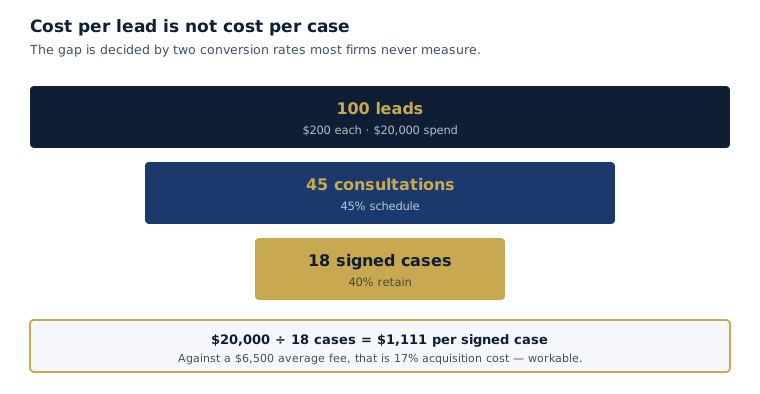
Cost per lead measures what you pay for an inquiry. Cost per signed case measures what you pay for a client. The distance between them is entirely determined by two conversion rates most firms have never measured: how many leads schedule a consultation, and how many consultations end in a signed fee agreement.
Firms consistently overestimate both. The felt sense is that most people who call end up hiring you, because the ones who did are the ones you remember. The actual numbers are usually sobering.
Running the Calculation
Three inputs, one output.
Cost per signed case = Cost per lead ÷ (Lead-to-consultation rate × Consultation-to-retainer rate)
A $200 lead with a 50% scheduling rate and a 40% retainer rate produces one signed case for every five leads, at $1,000 per case. The same $200 lead at 30% and 25% requires thirteen leads and costs $2,667 per case. Identical lead price, entirely different business.
Six Practice Areas, Worked Through
| Practice Area | Lead Cost | Leads / Case | Cost / Case | Avg Fee | % of Fee |
|---|---|---|---|---|---|
| Personal Injury | $275 | 7.1 | $1,964 | $28,000 | 7% |
| Criminal / DUI | $150 | 4.5 | $675 | $8,500 | 8% |
| Family Law | $225 | 5.6 | $1,260 | $6,500 | 19% |
| Immigration | $200 | 4.8 | $960 | $4,500 | 21% |
| Estate Planning | $240 | 5.0 | $1,200 | $3,200 | 38% |
| Bankruptcy | $180 | 4.0 | $720 | $1,800 | 40% |
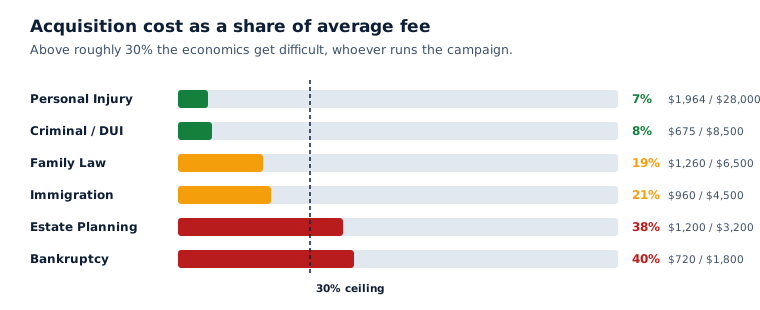
Two practice areas in that table are comfortable. Two are workable. Two are operating on margins where a single process failure turns a profitable channel into a losing one.
The Part Firms Avoid
Running this calculation honestly often reveals that a channel the firm has funded for a year is not profitable. That is uncomfortable, and the common response is to question the inputs rather than the conclusion.
The inputs are worth questioning, but specifically: are you counting all leads or only the ones your intake team logged? Are you counting consultations that were scheduled or consultations that actually happened? Is the average fee collected or billed? Tightening those definitions usually makes the number worse, not better.
What Actually Improves It
Three levers, in order of how much they typically move and how controllable they are.
Consultation-to-retainer rate is the most controllable and most neglected. A consistent consultation structure that ends with a clear ask rather than "think it over" moves this more than any other single change.
Lead-to-consultation rate is largely a speed problem. Responding in minutes rather than hours, and following up three to five times rather than once, routinely adds ten or more percentage points.
Lead cost is the lever firms reach for first and the one they control least, because it is set by the auction and by competitors. Tightening targeting and eliminating wasted spend helps, but the ceiling is lower than most firms assume.
Work through your numbers with someone who has practiced
A free consultation covering your case economics, conversion rates, and what your market actually charges — before you commit to any spend.
Our marketing budget guide extends this into a full budgeting framework, including how to set a ceiling and when to scale or cut a channel.
Common Questions
As a percentage of average fee, acquisition costs above roughly 25 to 30 percent become hard to sustain once overhead is accounted for. Personal injury firms commonly operate in the 5 to 10 percent range because case values are high. Bankruptcy and estate planning firms frequently run 25 to 40 percent, which is why intake efficiency matters disproportionately in those practices.
Divide your cost per lead by the product of your lead-to-consultation rate and your consultation-to-retainer rate. A $200 lead at 50 percent scheduling and 40 percent retaining yields $1,000 per signed case. Use collected fees rather than billed fees for the comparison, and count all leads received rather than only those your team logged.
Because conversion is failing somewhere between the inquiry and the fee agreement. Cheap leads are frequently cheap for a reason, such as broad targeting attracting people outside your practice area or geography. It can also reflect slow response times or consultations that end without a clear ask. Measure both conversion rates separately to see which stage is losing people.
Not before checking whether the problem is the channel or your intake. If lead quality is genuinely poor, meaning wrong practice area or wrong geography, that is a channel problem. If the leads are qualified but conversion is weak, that is an operations problem and changing channels will not fix it. Give any channel ninety days of honest measurement before deciding.