Someone gets rear-ended on a Tuesday afternoon. Two years ago they opened Google and typed "car accident lawyer near me." Today there is a reasonable chance they open ChatGPT or Claude and type something closer to how they would describe it to a friend: "I got hit by someone with no insurance in Pasadena, do I even need a lawyer for this?"
What comes back is not ten blue links. It is an explanation, some practical guidance, and often a handful of specific firms or a recommendation about how to find one. Whether your firm is in that answer is not something your rank tracker measures.
What Actually Changed
It is worth being precise about the shift, because it is narrower than the hype suggests and more consequential than skeptics allow.
What has not changed: people with urgent legal problems still overwhelmingly reach for their phone and still frequently end up on Google. The Map Pack still captures an enormous share of legal calls. Nobody should be moving budget out of local search on the basis of AI.
What has changed: the research phase increasingly happens in a conversation rather than a series of searches. Someone who would previously have run five separate Google searches over an evening now asks one assistant several follow-up questions and arrives at a shortlist. By the time they search Google, they may already know which firm they intend to call.
What These Answers Look Like
The systems behave differently from one another. Some answer from training data alone, producing general guidance with no specific firms named. Some search the live web and cite sources inline. Most now do both depending on the question.
For a question like "who is a good bankruptcy attorney in Beverly Hills," the answer typically includes some caveat about verifying credentials, advice on how to evaluate an attorney, and frequently a handful of named firms drawn from what the system can find and verify — directories, review profiles, firm websites with clear information.
Firms with ambiguous or inconsistent web presence do not get named, because the system cannot confidently establish that they exist, practice in that area, and serve that geography.
Why Some Firms Get Named and Others Do Not
The pattern is fairly consistent, and it rewards things that are good practice anyway.
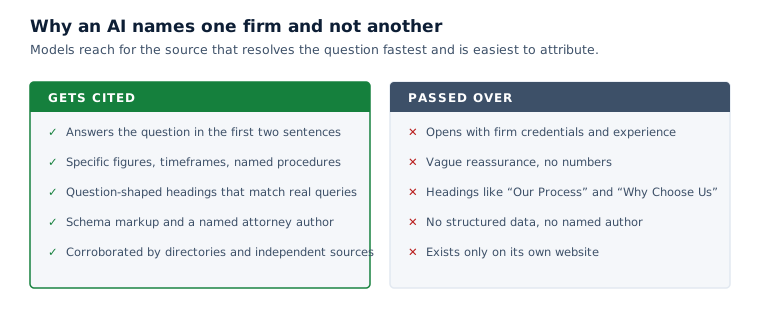
Firms that get cited have content that answers the specific question directly rather than describing services. They have consistent identity signals across their site, their Google Business Profile, and legal directories, so the system can establish who they are without ambiguity. They have named attorneys with real credentials and bio pages. And they are corroborated by independent sources — bar directories, legal directories, local coverage — rather than existing only on their own website.
Firms that do not get cited usually have thin practice area pages made mostly of marketing language, inconsistent business information across the web, and no independent corroboration.
Test Your Own Firm in Ten Minutes
You do not need a tool for this. Open ChatGPT, Claude, and Perplexity, and run four things.
Ask about your firm by name
"What can you tell me about [your firm name] in [your city]?" The answer reveals how clearly your entity is understood, and whether anything wrong has attached to it.
Ask the question a client would ask
Describe a typical client's situation in plain language and see which firms, if any, get named.
Ask for a recommendation directly
"Who are the best [practice area] attorneys in [your city]?" Note who appears and what sources are cited.
Ask a substantive legal question you have answered on your site
If your page is genuinely the clearest answer available, you may be cited. If a competitor is cited instead, read their page.
There is no support line for correcting an AI system's understanding. The fix is upstream: correct the underlying data on your website, your Google Business Profile, and every directory listing, then wait for re-crawling. Entity consistency is the only lever you have.
What to Do Now
Nothing here calls for abandoning what already works. The practical moves are additive and mostly improve conventional search performance as well.
Make your business information identical everywhere it appears. Add comprehensive schema to your site. Restructure your most important practice area pages so each section leads with a direct answer under a question-shaped heading. Publish an llms.txt file. Attribute content to a named attorney with a real bio. And write the pages that answer what clients actually ask rather than the pages that describe what you sell.
Our AI search optimization guide covers each of these in detail.
Find out what AI says about your firm
Our free audit includes checking how ChatGPT, Claude, and Perplexity currently describe your firm and your market — and what it would take to be cited.
Common Questions
A growing share use AI assistants during the research phase, particularly for understanding their situation and building a shortlist, before moving to Google to verify and call. Urgent searches still skew heavily toward conventional search on mobile. The practical implication is that AI visibility is additive to local search rather than a replacement for it.
No. There is no advertising inventory in AI-generated answers from the major assistants, and no vendor can sell placement. Citation is earned by being the clearest, most specific, and most verifiable source on the question being asked.
It changes where some traffic goes rather than eliminating it. Informational queries that once produced a click to your blog may now be answered in the AI response. Commercial queries where someone is ready to hire still produce clicks and calls. The response is to ensure your firm is named in the answers, not to stop investing in search.
Entity consistency. Make your firm name, address, phone number, and practice areas identical across your website, Google Business Profile, and every directory listing. An AI system cannot confidently recommend a firm whose identity is ambiguous across sources, regardless of how good your content is.